Updated October 28, 2026
Acne-prone skin does not need the longest routine. It needs a routine that removes sweat, sunscreen and makeup without repeated irritation, supports the skin when treatment feels drying, and makes it easy to use one evidence-based active consistently.
This guide applies the strengths of Korean skincare—light textures, careful layering and barrier-focused moisturizers—without treating “K-beauty” as a cure. Acne is a medical skin condition. Cosmetics can support comfort and appearance, while products sold as acne treatments have different ingredients, directions and regulatory requirements.
Quick answer: the simplest routine
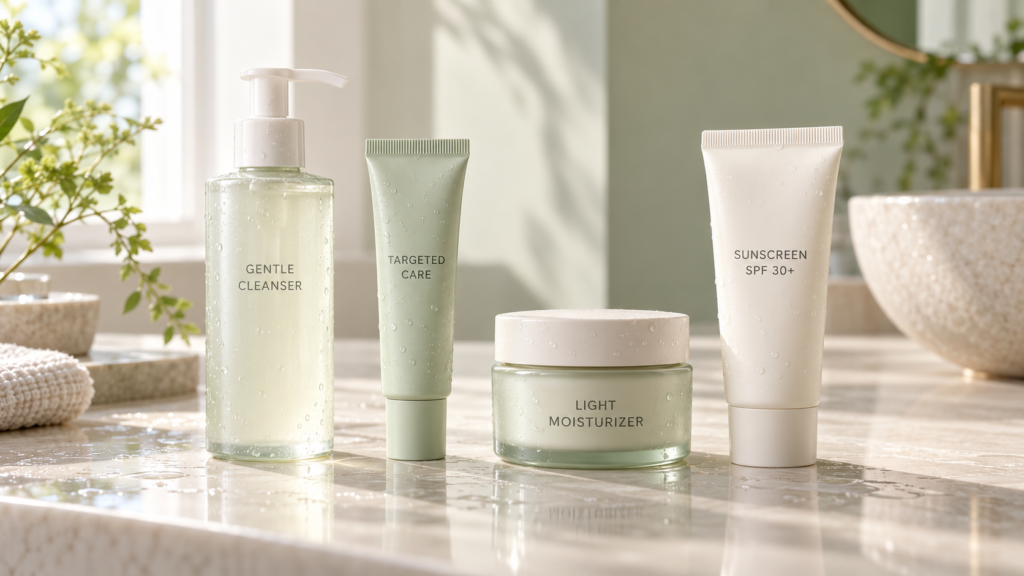
Morning: gentle cleanse or water rinse → light moisturizer if needed → broad-spectrum sunscreen SPF 30 or higher.
Night: remove makeup or water-resistant sunscreen → gentle cleanser → one acne treatment used according to its label or a dermatologist’s plan → moisturizer.
If a toner, essence or serum does not solve a clear problem, it is optional. A short routine that you tolerate is more useful than a complicated routine that causes stinging, peeling or constant product switching.
Skincare support and acne treatment are different jobs
A cleanser, moisturizer and sunscreen create the working environment for an acne plan. They can reduce avoidable irritation and help the skin feel comfortable. They do not automatically treat acne just because the label uses words such as “clarifying,” “pore,” “trouble care” or “balancing.”
The U.S. Food and Drug Administration explains that a cosmetic claim must be truthful and not misleading. When a product claims to treat or prevent disease or affect the body’s structure or function, it is regulated as a drug rather than only as a cosmetic. That distinction matters when reading K-beauty marketing translated for international shoppers.
| Product role | What it can reasonably do | What to verify |
|---|---|---|
| Cleanser | Remove oil, sweat, makeup and debris | Comfort after rinsing; no harsh scrubbing required |
| Hydrating layer | Add lightweight water-binding ingredients | Whether it improves comfort without adding stickiness |
| Acne treatment | Use an active with evidence for a specific type of acne | Active ingredient, strength, directions and warnings |
| Moisturizer | Reduce dryness and support treatment tolerance | Texture, fragrance preference and non-comedogenic labeling |
| Sunscreen | Protect exposed skin from ultraviolet radiation | Broad-spectrum SPF 30+, water resistance when needed |
Morning routine for acne-prone skin
1. Cleanse gently—or rinse when that is enough
The American Academy of Dermatology recommends a gentle, non-abrasive cleanser, lukewarm water and fingertips rather than washcloths or rough tools. It also advises limiting face washing to twice daily and after heavy sweating. Washing more often or chasing a “squeaky clean” feeling can add irritation without solving the cause of acne.
If your skin is dry from treatment and you wake without heavy residue, a water rinse may feel better. Oily skin may prefer a mild foaming cleanser. Judge the cleanser by the result: skin should feel clean and comfortable, not tight for the next hour.
2. Use one optional hydrating layer
A watery toner or essence can help when treatment leaves the skin dehydrated. Look for simple humectant-focused formulas with ingredients such as glycerin or hyaluronic acid. Multiple layers are not required. Skip this step if moisturizer alone is comfortable.
Fragrance-free products may suit people who already know fragrance triggers irritation, but “natural,” “clean” and “hypoallergenic” are not guarantees that a formula will agree with every person.
3. Moisturize when your skin needs it
Moisturizer is not only for dry skin. The AAD notes that common acne treatments—including benzoyl peroxide, salicylic acid and topical retinoids—can dry or irritate the skin, and that moisturizer can help people tolerate a treatment plan. Look for descriptions such as “oil-free,” “non-comedogenic” or “won’t clog pores” when useful.
A gel-cream can be comfortable in humid weather or on oilier areas. A lotion or cream may fit dry cheeks, cold weather or a more drying treatment. Combination skin can use different amounts in different zones.
4. Finish with sunscreen
Choose a broad-spectrum sunscreen with SPF 30 or higher and apply it as directed. Reapply according to the label, especially outdoors, after swimming or after sweating. A lightweight Korean sunscreen can make daily use easier, but finish and comfort do not replace correct application.
If you are comparing textures, see our MEDIHEAL sun serum analysis. The review separates cosmetic finish from treatment claims.
Night routine for acne-prone skin
1. Remove what you wore
When you wore makeup or a water-resistant sunscreen, use an appropriate remover, cleansing oil or balm first. Follow with a gentle water-based cleanser only when residue remains or the second cleanse is comfortable. Double cleansing is a tool, not a nightly rule.
Our Korean double cleansing guide explains how to choose between an oil and a balm without over-cleansing.
2. Choose one treatment path
The AAD acne guideline supports several topical options, including benzoyl peroxide, topical retinoids, salicylic acid and azelaic acid. Which one fits depends on the type and severity of acne, other products, pregnancy status, sensitivity and medical history. Use over-the-counter medication according to its Drug Facts label, and follow a clinician’s directions for prescriptions.
| Active | Typical role | Routine caution |
|---|---|---|
| Salicylic acid | Helps unclog pores and exfoliate inside the pore | Reduce frequency if dryness or stinging develops |
| Benzoyl peroxide | Reduces acne-causing bacteria | Can be drying and may bleach fabric |
| Adapalene or another topical retinoid | Helps prevent clogged pores and treats several acne types | Introduce as directed; irritation is possible |
| Azelaic acid | Used for acne and post-acne discoloration in appropriate formulas | Strengths and regulatory status vary by market |
Do not start several strong actives on the same night simply because each one is popular. If irritation occurs, it becomes difficult to identify the cause. A treatment plan from a dermatologist may intentionally combine therapies, but that is different from unplanned product stacking.
3. Moisturize and stop
Apply moisturizer after treatment unless the product directions or your clinician say otherwise. Some people prefer moisturizer before and after a retinoid to buffer dryness, but medication instructions should take priority. Avoid covering an irritated face with several new “soothing” products at once.
Where Korean skincare can help
Korean skincare can make a routine easier to live with. Lightweight sunscreens, fluid lotions and hydrating essences offer many texture options. Barrier-focused formulas can be useful when an acne treatment feels drying. The value is in formulation and fit, not country of origin alone.
“Heartleaf,” centella, mugwort and fermented ingredients are frequently marketed for trouble care. These ingredients may contribute to a pleasant, conditioning formula, but the presence of a botanical extract does not prove that the finished cosmetic treats acne. Evaluate the entire formula, the product category and the claim language.
For an example of this distinction, read our Anua Heartleaf serum analysis.
Adjust the routine to your skin
Oily skin with frequent clogged pores
Use a mild cleanser, a light non-comedogenic moisturizer and sunscreen. Choose one treatment that matches the problem. Oiliness does not require alcohol-heavy toners, rough pads or repeated washing.
Dry, peeling skin during treatment
Pause optional exfoliation, use a gentler cleanser and increase moisturizer where needed. Persistent burning, cracking or swelling is a reason to stop and seek professional advice rather than adding more products.
Sensitive or reactive skin
Keep the base routine stable for several days before adding an active. Patch testing may reveal an immediate reaction to a cosmetic, but it cannot guarantee that a leave-on treatment will remain comfortable with repeated use. Introduce one product at a time.
Post-acne dark marks
Daily sunscreen matters because ultraviolet exposure can deepen visible discoloration. Ingredients marketed for brightening should be evaluated separately from active acne treatment. Avoid picking, which increases the risk of scars and dark marks.
A four-week routine reset
| Week | Plan | What to record |
|---|---|---|
| 1 | Gentle cleanser, moisturizer, sunscreen | Tightness, oiliness, stinging and product pilling |
| 2 | Add one treatment according to its directions | Frequency, location of breakouts and irritation |
| 3 | Keep the routine stable | Whether dryness is improving or increasing |
| 4 | Review adherence and tolerance | Progress photos in similar lighting; questions for a clinician |
Four weeks is a routine-building checkpoint, not a promise that acne will clear on a fixed schedule. The AAD notes that acne treatment often needs time. Switching every few days can irritate skin and prevents a fair assessment.
Common mistakes that work against the routine
- Scrubbing or using cleansing brushes aggressively. Friction can irritate active breakouts.
- Washing every time the skin looks shiny. Stick to gentle cleansing and wash after sweating.
- Using an acid toner, exfoliating pads and a retinoid together immediately. Start one deliberate treatment path.
- Skipping moisturizer because skin is oily. Treatment-related dryness still needs support.
- Changing products before you can judge them. Keep notes and change one variable at a time.
- Popping or squeezing. This increases the risk of prolonged healing, scarring and discoloration.
- Assuming every “pore” product treats acne. Verify whether it is a cosmetic or an acne medication.
When professional care is the better next step
See a board-certified dermatologist or qualified healthcare professional for deep, painful or cyst-like breakouts; acne that is scarring; sudden severe acne; significant distress; or acne that does not improve with an appropriate over-the-counter plan. Seek help promptly for swelling, blistering, breathing difficulty or another serious reaction after using a product.
Pregnancy, plans for pregnancy and breastfeeding can change which acne treatments are appropriate. Ask a healthcare professional before using a retinoid or when uncertain about a medication.
Shopping checklist
- A gentle cleanser that does not require scrubbing
- One clearly labeled acne treatment, if appropriate
- A moisturizer with a texture you will use consistently
- A broad-spectrum sunscreen SPF 30 or higher
- Complete ingredient and Drug Facts information where applicable
- A responsible seller and packaging appropriate for the formula
- No expectation that “detox,” “poreless” or “overnight” language guarantees a result
Editorial verdict
The best Korean skincare routine for acne-prone skin is a disciplined base routine with one treatment decision. Gentle cleansing, moisturizer and sunscreen are not glamorous, but they make it easier to use an acne active consistently and to recognize irritation early.
Add a toner, essence or serum only when it has a defined role. Natural texture and visible pores remain normal. The goal is a routine that supports treatment, protects the skin and can be followed long enough to evaluate honestly.
Official sources
- American Academy of Dermatology: Face washing 101
- American Academy of Dermatology: Why acne-prone skin may need moisturizer
- American Academy of Dermatology: Acne clinical guideline highlights
- American Academy of Dermatology: Skin-care habits that can worsen acne
- U.S. Food and Drug Administration: Cosmetics labeling claims