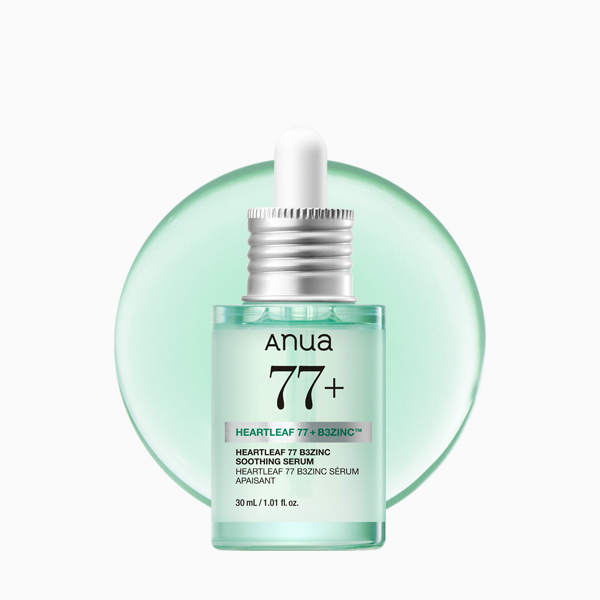
Anua Heartleaf 77 B3 Zinc Trouble Serum is a Korean-market facial serum built around 77% heartleaf flower, leaf and stem water, 5% niacinamide and 1% zinc PCA. Anua’s official Korean listing names it 어성초 77 B3징크 트러블 세럼 and identifies it as a 30 mL product made in Korea. The ingredient percentages, size and manufacturer details in this review were checked against the official Anua Korea product page.
In Korean cosmetics, “trouble care” usually describes products positioned for blemish-prone, congested or easily unsettled skin. It is not a medical claim. This serum is better understood as a lightweight conditioning formula than as an acne treatment, and the most useful question is whether its niacinamide-and-zinc profile fits your routine.
Quick verdict
Worth considering if: you want a light, fragrance-free serum with niacinamide, humectants and a small amount of zinc PCA for everyday oil-and-moisture balancing.
Think twice if: you expect a concentrated acne treatment, dramatic pore reduction or a rich barrier-repair finish.
Bottom line: Anua Heartleaf 77 B3 Zinc Soothing Serum is best understood as a lightweight conditioning and soothing serum with blemish-prone-skin positioning—not as a substitute for a dedicated exfoliant or an over-the-counter acne active.
What is Anua Heartleaf 77 B3 Zinc Soothing Serum?
This is a 30 mL Korean facial serum made by Anua and manufactured in South Korea by Kolmar Korea, with The Founders listed as the responsible distributor. English-language retailers may translate the Korean “Trouble Serum” name differently, so verify the 30 mL size and the 77% heartleaf water, 5% niacinamide and 1% zinc PCA formula rather than relying only on an English title.
The formula is water-based and relatively simple compared with many multi-active Korean serums. Its front-loaded ingredients are heartleaf water, niacinamide, panthenol, glycerin and zinc PCA. Lower in the ingredient list are gluconolactone, tocopherol, allantoin, dipotassium glycyrrhizate and capryloyl salicylic acid.
Anua positions the serum for all skin types, but the ingredient structure makes it particularly relevant to combination, oily and blemish-prone shoppers who dislike heavy textures. Dry or reactive skin can still use it, although it may need to be paired with a more substantial moisturizer.
Korean-market context
Anua sells the serum through its official Korean storefront as part of its heartleaf range. The brand specifies a 30 mL size, suitability for all skin types, a 36-month shelf life and use within 12 months after opening. Those details establish the product identity; they do not prove that it will treat acne or irritation.
The formula follows a familiar K-beauty “trouble care” direction: a lightweight botanical-water base paired with niacinamide, zinc PCA, panthenol and humectants. That combination can appeal to shoppers who want daily oil-and-moisture balance without the feel of a heavy cream. Availability, promotions and retailer rankings change quickly, so this review does not use a temporary sales rank as evidence of performance.
Key ingredients and what they do
Heartleaf water: 77%
Heartleaf, or Houttuynia cordata, is used in Korean skincare for formulas aimed at comfort, oil balance and a calmer-looking complexion. Here it appears as heartleaf flower, leaf and stem water at 77%.
The percentage sounds impressive, but it should be read in context. A botanical water is not automatically equivalent to a 77% concentration of purified heartleaf extract. The finished formula also contains water and other solvents, and the product does not provide a standardized amount of every heartleaf compound.
For shoppers, the practical takeaway is simple: heartleaf gives the serum its soothing, lightweight identity, but it should not be treated as a guaranteed solution for redness, acne or inflammation.
Niacinamide: 5%
Niacinamide is a versatile cosmetic ingredient used in formulas targeting uneven-looking tone, excess shine and the appearance of enlarged pores. At 5%, it is present at a meaningful but generally approachable level for many users.
Niacinamide can support a more balanced-looking complexion over time, but results depend on the full routine, consistency and individual tolerance. It is not a bleaching ingredient, and the serum should not be described as a treatment for pigmentation disorders.
Zinc PCA: 1%
Zinc PCA combines zinc with PCA, a humectant-related component. In skincare, it is commonly included in products designed for oily or blemish-prone skin because of its oil-balancing and conditioning positioning.
The 1% level is clearly stated in the Korean product information. Still, the formula should be judged as a whole. Zinc PCA does not make this a prescription-strength or drug-style acne product, and it should not be expected to replace proven acne medications.
Panthenol and humectants
Panthenol appears near the top of the ingredient list, alongside glycerin, butylene glycol, propanediol and trehalose. These ingredients help the formula attract and hold water, which can make skin feel softer and less tight after cleansing.
They are especially useful in a lightweight serum because they add hydration without relying on heavy oils or occlusive waxes. If your skin loses moisture quickly, follow with a moisturizer rather than using this serum alone.
Gluconolactone and capryloyl salicylic acid
Gluconolactone is a polyhydroxy acid, while capryloyl salicylic acid is a salicylic-acid-derived exfoliating ingredient. Both appear well below the headline ingredients in the listed formula.
Their presence adds interest for shoppers concerned with texture or congestion, but the ingredient list does not establish the concentration or strength of exfoliation. It would be inaccurate to market Anua Heartleaf 77 B3 Zinc Soothing Serum as a dedicated exfoliating treatment on this basis alone.
Texture and finish
The serum has a thin, watery-to-light gel texture. It spreads quickly and leaves a fresh, lightly hydrated finish rather than a rich or oily coating. The official product information does not list added fragrance, which may appeal to shoppers who prefer simpler sensory formulas.
Because the texture is light, it layers easily under moisturizer and sunscreen. On very oily skin, one layer may be enough. On dehydrated skin, two thin layers can provide a more cushioned feel, although applying more product will not necessarily create better results.
The finish is closer to soft hydration than instant glass-skin shine. If you want a glossy, emollient serum, this may feel too restrained. If you dislike sticky or silicone-heavy formulas, its quick-spreading texture is more likely to suit you.
Best and poor fits by skin type
Best fits
- Combination skin: The water-based texture and zinc PCA positioning make it a practical option for an oily T-zone with normal or slightly dry cheeks.
- Oily skin: It provides lightweight hydration without a heavy oil layer. Use a gel moisturizer if additional comfort is needed.
- Blemish-prone skin: The formula is designed around heartleaf, niacinamide and zinc PCA, making it relevant to shoppers who want a simple daily serum rather than multiple strong actives.
- Dull-looking skin: The 5% niacinamide level may fit a routine focused on more even-looking tone and surface brightness.
Potentially poor fits
- Very dry skin: The serum may feel too light on its own and will need a cream or balm over it.
- Highly reactive skin: Although the formula is positioned as soothing, botanical waters and multiple active-support ingredients can still disagree with individual skin. Patch testing is sensible.
- Those seeking a direct acne treatment: This is a cosmetic serum, not a substitute for benzoyl peroxide, adapalene or professional care.
- Those wanting a rich barrier formula: The ingredient list contains humectants and panthenol but no prominent ceramide-and-lipid system.
How to use it
- Cleanse gently and apply toner if you use one.
- Dispense a small amount of Anua Heartleaf 77 B3 Zinc Soothing Serum.
- Spread it over the face, avoiding the immediate eye area, then press lightly until absorbed.
- Follow with moisturizer. Apply broad-spectrum sunscreen in the morning.
Start once daily if your routine already contains exfoliating acids, retinoids or high-strength niacinamide products. Although the formula is not presented as a strong exfoliant, its ingredient list includes gluconolactone and capryloyl salicylic acid, so cautious layering is sensible for easily irritated skin.
Do not apply it to broken skin. If persistent stinging, itching or visible irritation develops, stop using it. Product packaging and regional ingredient listings should be checked before purchase because formulas and labels can change by market.
Strengths
- The official formula clearly discloses 77% heartleaf water, 5% niacinamide and 1% zinc PCA.
- Uses a clear, easy-to-understand combination of heartleaf, niacinamide and zinc PCA.
- Light texture suits layering and warmer weather.
- No added fragrance is listed in the official ingredient information reviewed for this article.
- The official Korean listing provides the full ingredient list, size, manufacturer and usage details.
- More focused than a generic hydrating serum, but less aggressive than a treatment-heavy formula.
Limitations
- The product does not disclose the concentration of every highlighted botanical or supporting active.
- “Trouble care” is a cosmetic positioning term, not evidence of medical acne treatment.
- The formula may be too light for very dry or severely dehydrated skin.
- Niacinamide and zinc PCA can still cause discomfort for some users, despite their generally broad use in skincare.
- The presence of low-list exfoliating ingredients does not guarantee meaningful pore or texture correction.
- Popularity in Korea does not prove that it will outperform every comparable soothing serum.
Buyer checklist
- Confirm that the package says either Heartleaf 77 B3 Zinc Soothing Serum or the Korean product name 어성초 77 B3징크 트러블 세럼.
- Check whether you are buying the individual 30 mL bottle or a refill or double set.
- Review the ingredient list on the package if you have sensitivities.
- Buy from Anua’s official site, an authorized retailer or a reputable Korean beauty seller.
- Do not choose it solely because of the word “zinc” if your main concern requires a dedicated acne active.
- Compare the cost per 30 mL rather than judging a bundle by its headline discount.
Alternatives and comparisons
| Product | Best for | How it differs |
|---|---|---|
| Anua Heartleaf 77 B3 Zinc Soothing Serum | Light oil-and-moisture balancing | Combines 77% heartleaf water with 5% niacinamide and 1% zinc PCA. |
| Anua Heartleaf 77 Soothing Toner | Simple hydration and layering | More toner-like and less targeted toward niacinamide-and-zinc care. |
| Abib Mugwort TECA Capsule Serum Calming Drop | Comfort-focused hydration | Uses a different botanical-centered calming concept and a more capsule-style serum presentation. |
| Purito Wonder Releaf Centella Serum Unscented | Centella-focused soothing care | More centered on centella and barrier-support ingredients than zinc PCA. |
| COSRX The Niacinamide 15 Serum | Higher-strength niacinamide routines | More active-forward and potentially less forgiving for users who prefer gentle daily formulas. |
Transparent editorial note
Updated October 5, 2026. This assessment is based on Anua’s official Korean product information, including its published size, manufacturer details and complete ingredient deck. It does not include an independent wear test, laboratory testing or a clinical evaluation by TENCHOICE BEAUTY.
Brand descriptions such as “soothing,” “trouble care” and “moisture balance” are marketing claims and should not be confused with medical outcomes. Ingredient functions in this article describe common cosmetic roles, not guaranteed individual results. The most defensible reason to consider Anua Heartleaf 77 B3 Zinc Soothing Serum is its straightforward, lightweight profile and transparently documented formula—not the promise of a dramatic overnight transformation.