Updated October 18, 2026.
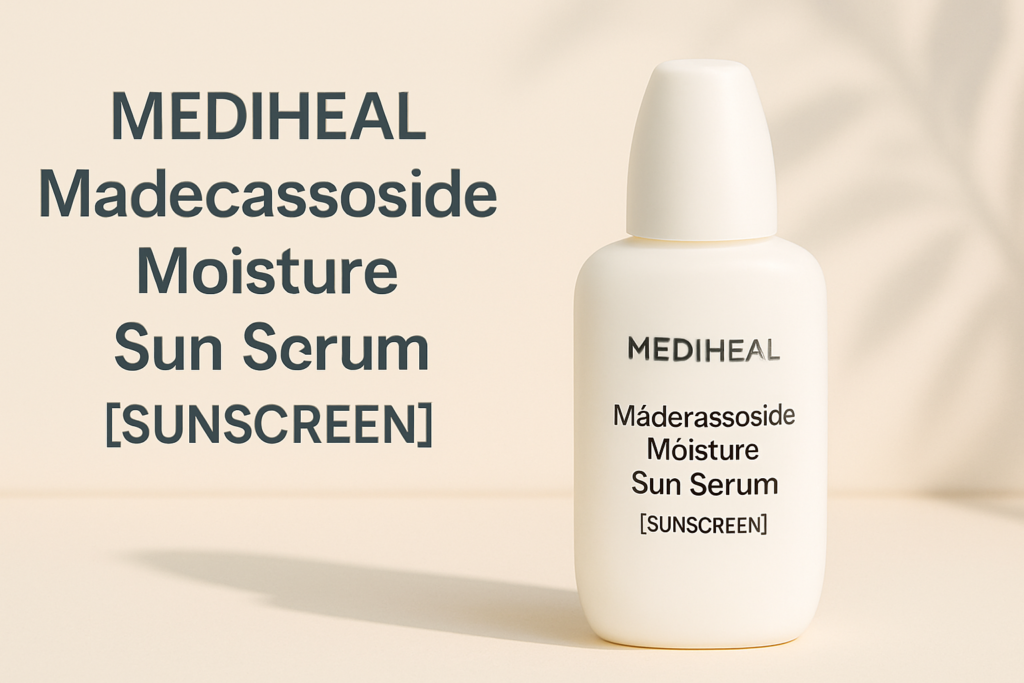
MEDIHEAL Madecassoside Moisture Sun Serum [SUNSCREEN] brings a familiar Korean skincare idea—the serum-textured daily sunscreen—into MEDIHEAL’s madecassoside-focused product family.
The product is sold through MEDIHEAL’s official U.S. store and global K-beauty retailers. The brand describes the U.S. formula as a lightweight SPF 50+ sunscreen with hydration, soothing care and an invisible finish. Those points are brand claims, not independent performance findings, so the most useful question is more specific: what does the published formula actually suggest about its feel, finish and potential skin-type fit?
Quick verdict
Best for: shoppers who want a modern, lightweight sunscreen with a soft serum-lotion texture and no added white cast from mineral filters.
Less suitable for: people avoiding fragrance, anyone seeking a mineral-only sunscreen, or shoppers who need a water-resistant outdoor formula and cannot confirm that claim on their local package.
Editorial verdict: a promising new Korean sunscreen for everyday city wear, especially for normal, combination and mildly dry skin. Its strongest selling point is the balance between UV protection, skincare-style ingredients and a finish designed to sit comfortably under makeup. Its main limitation is that the U.S. ingredient and labeling information should not automatically be treated as identical to every Korean-market version.
Product overview
MEDIHEAL Madecassoside Moisture Sun Serum is a 50 ml facial sunscreen listed by the brand with SPF 50+ broad-spectrum protection. The official U.S. product page identifies four active sunscreen ingredients: ensulizole at 2.50%, homosalate at 5.00%, octisalate at 4.50% and octocrylene at 5.00%.
Its supporting formula includes niacinamide, madecassoside, several forms of hyaluronic acid, centella asiatica extracts, madecassic acid, asiatic acid, asiaticoside, tocopherol and a ferment extract. The brand positions the product as a sunscreen that also provides hydration and soothing care. In practical terms, this is not simply a watery SPF mist or a transparent gel. The ingredient list points to a lightweight emulsion containing film-forming, emollient and silicone-based components intended to spread evenly and leave a smooth surface.
MEDIHEAL is a Korean skincare brand operated by L&P Cosmetic, and the official site lists the company location in Seoul, Republic of Korea. The product is available through MEDIHEAL’s U.S. store and Olive Young Global, making it accessible to shoppers outside Korea. The U.S. and Korean-market listings should still be checked separately because sunscreen filters, claims and labeling can vary by market.
Key ingredients and what each does
UV filters: ensulizole, homosalate, octisalate and octocrylene
These are the formula’s listed active sunscreen ingredients in the U.S. presentation. Together, they are used to provide broad-spectrum sun protection in a chemical-filter format. Because the product is not presented as a mineral sunscreen, it does not rely on zinc oxide or titanium dioxide for its primary UV-filter system.
The exact balance of UV protection, stability and cosmetic feel depends on the finished formula, application amount and regulatory market. SPF is also highly dependent on applying enough product and reapplying appropriately. A thin layer used as a makeup primer should not be treated as equivalent to the labeled sunscreen application.
Niacinamide
Niacinamide is a versatile cosmetic ingredient commonly used to support the appearance of uneven tone, excess oil and a more resilient-looking skin surface. It is listed relatively high in the inactive-ingredient section, although the brand does not disclose its percentage on the official page. That means shoppers should not assume a specific concentration or expect the same performance as a dedicated high-percentage niacinamide serum.
Madecassoside and centella asiatica
Madecassoside is a compound associated with Centella asiatica, also known as cica. The formula contains madecassoside, Centella asiatica leaf extract, Centella asiatica extract and related centella compounds including madecassic acid, asiatic acid and asiaticoside.
In a cosmetic formula, these ingredients are generally included for soothing and skin-conditioning purposes. They may appeal to shoppers who prefer sunscreen formulas that are designed to feel comfortable on skin that is easily bothered by dryness or environmental exposure. However, “soothing” should be understood as a cosmetic positioning term, not a promise to treat a skin condition.
Hyaluronic acid forms and hydroxyethyl urea
The ingredient list includes sodium hyaluronate, hydrolyzed hyaluronic acid and hydrolyzed sodium hyaluronate, plus hydroxypropyltrimonium hyaluronate. These water-binding ingredients are used to help the formula feel more hydrating and cushioned. Hydroxyethyl urea is another humectant commonly used to support a softer, less tight after-feel.
The presence of several humectants does not necessarily mean the product will replace a moisturizer for dry skin. Humectants work within the overall formula, and the final feel also depends on the user’s climate, cleanser, moisturizer and application quantity.
Silicones, emollients and texture agents
Lauryl dimethicone, dimethiconol, vinyl dimethicone and other silicone-related ingredients appear alongside emollient solvents such as butyloctyl salicylate, C13-15 isoalkane and isododecane. These ingredients can help a sunscreen spread smoothly, reduce drag and create a more polished surface.
The formula also includes methyl methacrylate crosspolymer and polymethylsilsesquioxane, ingredients often used to improve slip, blur the look of surface texture or reduce a greasy impression. They help explain why the product is presented as a serum sunscreen rather than a heavy cream.
Texture and finish
MEDIHEAL describes the product as fast-absorbing, lightweight and free from visible white cast. The formula composition supports that general direction: it uses chemical UV filters, lightweight emollient solvents, humectants and silicones rather than a dense mineral-powder base.
Expect a fluid lotion or serum-emulsion texture rather than a watery essence. It should be easier to spread than a thick cream sunscreen, but it may still leave a soft, conditioned layer because the formula contains emollients and film-forming materials. That finish may be useful under makeup, particularly when skin is normal to dry or when a completely matte sunscreen feels uncomfortable.
Fragrance is listed as “Fragrance (Parfum).” This does not tell us how strong the scent will be in practice, but it is an important detail for fragrance-averse shoppers and for anyone whose skin tends to react to fragranced leave-on products.
Who is it best for?
Normal and combination skin
This is likely the most straightforward match. The formula aims to offer hydration without the dense finish associated with many cream sunscreens, while its silicone and emollient components may help the product sit smoothly over a light moisturizer.
Mildly dry skin
The humectants and emollient base may provide enough comfort for mildly dry skin in warm or humid weather. In a cold or very dry climate, many users will still prefer a separate moisturizer underneath. Sunscreen should not be forced to perform every step of a routine.
Oily skin
Oily skin may appreciate the lack of a mineral white cast and the potentially smooth application. However, “serum” does not automatically mean matte. The emollient and silicone blend may leave a soft sheen, so shoppers who prefer a dry-touch or powdery finish should consider a dedicated oil-control sunscreen instead.
Sensitive or fragrance-avoiding skin
The centella-derived ingredients may make the product appealing to shoppers who look for soothing-oriented formulas, but the presence of parfum means it is not the most cautious choice for fragrance-avoidant routines. Patch testing is sensible, especially if the product will be used daily over a large area.
Who may want to skip it?
- Shoppers who specifically want a fragrance-free sunscreen.
- People looking for a mineral-only zinc oxide or titanium dioxide formula.
- Anyone needing a clearly documented water-resistant sunscreen for swimming, heavy exercise or prolonged outdoor exposure.
- Users who dislike a hydrated or slightly luminous finish.
- Those who are sensitive to one or more chemical UV filters and already know they tolerate only another sunscreen format.
The official page does not present this product as a sport sunscreen or make a water-resistance claim. For beach days, hiking, outdoor work or heavy sweating, choose a product whose local label specifically supports that use.
How to use it
- Apply it as the final step of your morning skincare routine, after moisturizer if you use one.
- Shake the product before use, as directed by the brand.
- Apply a generous, even layer to the face and other exposed areas. Do not use only a tiny amount to achieve a lighter finish.
- Give it a short moment to settle before applying makeup, especially if you have layered several hydrating products underneath.
- Reapply when appropriate for your exposure, particularly after sweating, toweling or extended outdoor time.
If you are combining it with another active skincare product, introduce one new product at a time. The sunscreen itself is not an exfoliant or retinoid, but the fragranced formula may still be worth testing gradually if your routine is easily disrupted.
Strengths
- Skincare-style positioning: It combines SPF 50+ protection with humectants, centella-related ingredients and niacinamide.
- No mineral white-cast system: The listed active filters are chemical filters, which may be easier to blend across a wide range of skin tones.
- Potentially makeup-friendly finish: Silicones and texture agents may help create a smoother surface.
- Useful 50 ml size: The format is practical for regular facial use and travel.
- International availability: It is listed through MEDIHEAL’s U.S. store and Olive Young Global, giving shoppers more than one authorized purchase route.
Limitations
- Fragrance is present: This reduces its appeal for fragrance-free routines.
- No independent wear test here: The article does not claim that the sunscreen resists sweat, water, pilling or a full day of wear.
- Market differences matter: Sunscreen filters, claims and labeling can vary by country. Check the packaging sold in your market.
- Not automatically matte: A serum texture can still leave a moisturized or softly radiant finish.
- Ingredient percentages are limited: Aside from the listed UV filters, the brand does not disclose concentrations for niacinamide, madecassoside or hyaluronic acid on the product page.
Alternatives and comparison
| Product type | Choose it if you want | How it differs |
|---|---|---|
| MEDIHEAL Madecassoside Moisture Sun Serum | SPF 50+ with a serum-lotion feel and centella-derived ingredients | Fragranced chemical-filter formula with a skincare-focused positioning |
| Fragrance-free Korean sunscreen | A simpler option for scent-sensitive routines | May offer fewer sensorial or botanical additions, depending on the formula |
| Mineral sunscreen | Zinc oxide or titanium dioxide as the primary UV filters | May be more suitable for some filter preferences but can feel thicker or leave cast |
| Matte outdoor sunscreen | Oil control and stronger outdoor-wear positioning | Usually less serum-like and may feel drier under makeup |
Buyer checklist
- Confirm the exact product name and active-filter list on the package sold in your country.
- Check whether fragrance is acceptable for your routine.
- Decide whether you want a soft hydrated finish or a dry-touch finish.
- Look for a water-resistance claim if you need sunscreen for swimming or intense exercise.
- Buy from MEDIHEAL’s official store or an authorized retailer to reduce the risk of an old, altered or counterfeit product.
- Remember that SPF performance depends on applying enough product and using it consistently.
For a different daily-SPF texture, compare our Beauty of Joseon vs Round Lab sunscreen guide. It explains how finish, climate and routine fit can matter more than choosing by brand popularity alone.
Final assessment
MEDIHEAL Madecassoside Moisture Sun Serum is a Korean sunscreen for shoppers who want daily UV protection to feel more like skincare than a separate protective layer. Its formula has a clear logic: chemical UV filters for a blendable finish, humectants for comfort, silicones for slip, and madecassoside-plus-centella ingredients that align with MEDIHEAL’s soothing-oriented identity.
It is not a universal recommendation. The fragrance, lack of a documented water-resistance claim and possible variation between regional versions are meaningful caveats. Still, for normal, combination or mildly dry skin seeking a smooth everyday sunscreen with a fresh Korean-beauty texture, it is an appealing MEDIHEAL option for shoppers comparing lightweight daily Korean sunscreens.
Official sources checked
- MEDIHEAL US product page — size, SPF claim, U.S. active ingredients, full ingredient list and directions.
- Olive Young Global product listing — Korean-market name, 50 g size and retailer description.
Transparent editorial note: This assessment is based on the official product information and published ingredient list, plus current authorized-retailer information. TENCHOICE BEAUTY did not conduct laboratory SPF testing, wear testing, ingredient concentration analysis or an in-person application trial. Brand descriptions are identified as brand claims; texture, skin-type fit and limitations are editorial interpretations of the available formula and labeling information.