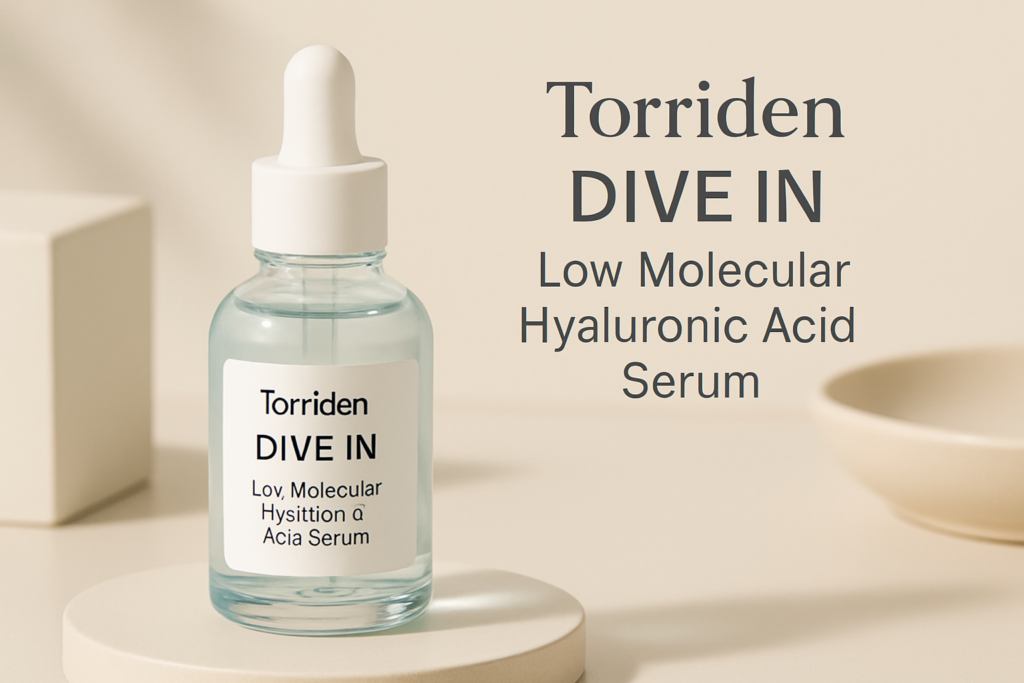
Updated September 16, 2026. Among Korean skincare products that have crossed successfully from local retail into international routines, Torriden DIVE IN Low Molecular Hyaluronic Acid Serum is unusually easy to understand. It is not built around a complicated treatment story. Its central idea is hydration: several forms of hyaluronic acid supported by humectants, panthenol, soothing-oriented ingredients and a small amount of barrier-supportive lipids.
That simplicity is part of the reason the product continues to attract attention. The serum appears in Olive Young’s current best-seller ecosystem in the United States, while Torriden’s Korean site continues to feature the DIVE IN range prominently, including an upgraded serum campaign in 2026. Independent Korean retail and beauty-platform references have also kept the DIVE IN line visible in hydration and serum discussions.
The important distinction is that popularity does not prove that a product will transform every skin type. This is a moisture-focused serum, not a complete routine and not a substitute for sunscreen, cleanser or moisturizer. Its value depends on whether your skin needs a light, layerable water-binding step.
Quick verdict
Best for: Normal, combination, oily or dehydrated skin that prefers a light serum and a fresh, non-oily finish.
Why it stands out: A straightforward hydration formula combining five listed hyaluronic-acid forms with glycerin, panthenol, trehalose, betaine and barrier-oriented ingredients.
Watch-outs: It may feel too light for very dry skin used alone, and the listed witch-hazel extract may not suit every highly reactive routine.
Bottom line: A credible everyday Korean hydration serum, especially useful under moisturizer or sunscreen, but not a miracle product or a replacement for richer emollient care.
Product overview
Torriden identifies the product as DIVE IN Low Molecular Hyaluronic Acid Serum. The official product information lists 50 ml, 70 ml and 40 ml formats, depending on market and availability. The brand describes the formula as a high-hydration serum using a 5D complex of low-molecular-weight hyaluronic acid.
“5D” is a brand formulation term rather than a universal industry standard. In the published ingredient list, the formula includes sodium hyaluronate, hydrolyzed hyaluronic acid, sodium acetylated hyaluronate, sodium hyaluronate crosspolymer and hydrolyzed sodium hyaluronate. These ingredients are related hyaluronic-acid materials, but their presence alone does not establish that water reaches different biological “layers” of skin in the dramatic way some marketing language may imply.
What can be verified is more practical: the serum contains multiple water-binding ingredients in a light, water-based formula. The product is also sold through international channels, including Olive Young’s global retail operation and Torriden’s regional websites, which makes it relatively accessible to shoppers outside Korea.
Key ingredients and what each does
Five listed hyaluronic-acid forms
Hyaluronic acid and its salts or modified forms are humectants. In a cosmetic formula, they help bind water and can make skin feel more hydrated and cushioned. Different forms vary in molecular size, structure and film-forming behavior. It is more accurate to view this blend as a way of creating a layered sensory and hydration profile than to assume that each form travels to a separate skin depth.
Glycerin and glycols
Glycerin appears high in the ingredient list, alongside butylene glycol, dipropylene glycol and propanediol. These are common humectant or solvent ingredients used to help attract and retain water while keeping a serum spreadable. They also contribute to the product’s fluid slip and quick-drying feel.
Panthenol
Panthenol is a provitamin B5 ingredient widely used in moisturizers and serums for its conditioning and humectant properties. In this formula, it reinforces the moisture-focused design. Its presence does not mean the product treats a medical skin condition; it simply helps support a comfortable, conditioned skin feel.
Trehalose and betaine
Trehalose and betaine are additional water-associated ingredients. They help the formula maintain a hydrated, flexible finish rather than relying only on hyaluronic acid. This supporting network is useful because a serum built around one hero ingredient can otherwise feel less balanced in real-world layering.
Allantoin and madecassoside
Allantoin is commonly used as a skin-conditioning ingredient. Madecassoside, a component associated with Centella asiatica, is also frequently included in products designed for a comfortable, soothing-oriented skin feel. The formula contains madecassic acid as well. These ingredients are best understood as supporting comfort, not as proof of a medical or dermatological effect.
Ceramide NP, cholesterol and beta-glucan
Ceramide NP and cholesterol are skin-identical or skin-associated lipid ingredients often used in barrier-oriented cosmetic formulas. Here, they appear after the principal humectants, so this is still primarily a hydration serum rather than a rich lipid cream. Beta-glucan adds another conditioning and moisture-supporting element.
Witch-hazel extract
The ingredient list includes Hamamelis virginiana leaf extract, commonly known as witch hazel. It is used in many cosmetic formulas for its astringent or skin-conditioning associations. Some people enjoy the fresh feel of witch-hazel products, while others with very reactive skin prefer to avoid them. Ingredient tolerance is individual, so patch testing is sensible if your routine is easily irritated.
Texture and finish
The published formula suggests a thin, water-gel serum rather than an oil serum or cream. Glycerin, glycols and polymeric ingredients can create slip and a lightly cushioned film, while the absence of heavy oils or waxes points toward a relatively fresh finish.
Applied in a modest amount to slightly damp skin, it should fit naturally between toner and moisturizer. On oily or combination skin, it may be comfortable as the main hydrating layer during warm weather. On dry skin, expect to need a cream or lotion over it because humectants do not provide the same occlusive protection as a richer moisturizer.
The finish is likely to look fresh rather than powder-matte. That does not mean it will create glass skin on its own. Visible glow depends on the rest of the routine, the amount applied, the moisturizer layered over it and the condition of the skin surface.
Who should use it—and who may not love it?
Good fits
- Normal skin: A simple daily hydration step without the weight of a rich cream.
- Combination skin: Useful when cheeks feel tight but heavier products make the T-zone uncomfortable.
- Oily skin: A lightweight alternative to adding more cream, particularly in humid weather.
- Dehydrated skin: Helpful when skin feels tight or lacks a comfortable water-rich finish, provided it is sealed with moisturizer.
- Beginners: A relatively easy product to understand because its main purpose is hydration rather than intensive exfoliation or retinoid-style treatment.
Poorer fits
- Very dry skin using it alone: The serum may not provide enough oil or occlusion to prevent moisture loss.
- Highly reactive skin: The witch-hazel extract may be a reason to patch test carefully.
- Shoppers seeking strong actives: This is not primarily a vitamin C, retinoid, exfoliating-acid or pigment-focused serum.
- Minimalists who already own a hydrating moisturizer: The extra step may be unnecessary if your cream already gives you the finish and comfort you want.
How to use Torriden DIVE IN Low Molecular Hyaluronic Acid Serum
After cleansing, apply toner if you use one, then spread one or two pumps of serum over the face and neck. The brand’s general direction is to apply an appropriate amount evenly and pat lightly. You do not need to layer a large quantity to make the formula work harder.
Follow with moisturizer. This step matters most for dry or dehydrated skin because a water-binding serum is not the same as an occlusive cream. In the morning, finish with broad-spectrum sunscreen as the final skincare step.
If you use exfoliating acids, retinoids or other potentially irritating products, introduce this serum separately so you can identify what your skin likes. It can usually be placed in a simple routine, but “hydrating” does not guarantee that every individual will tolerate every botanical extract.
Strengths
- Clear product purpose: The formula is focused on water-based hydration rather than trying to solve every concern at once.
- Layerable texture: The water-based structure should work under creams, makeup and sunscreen for many users.
- Broad supporting formula: Glycerin, panthenol, trehalose, betaine, allantoin, beta-glucan and selected lipids complement the hyaluronic-acid blend.
- International availability: Torriden has developed regional and global retail channels, making the product easier to verify and repurchase than many small Korean launches.
- Useful for routine building: It can add hydration without forcing shoppers to replace their existing cleanser, moisturizer or sunscreen.
Limitations
- Not a complete moisturizer: Very dry skin may still need a cream containing richer emollients or occlusives.
- “Low molecular” is not a guarantee: Molecular-size marketing should not be interpreted as proof of deep delivery or superior results for every person.
- Potentially unnecessary for some routines: If your moisturizer already contains plenty of humectants, adding a separate serum may offer only a modest difference.
- Formula versions can vary: The brand and retailers advise checking the packaging because ingredient lists may change by update or market.
- Not a treatment product: It is not designed to replace targeted products for concerns such as acne, pigmentation or lines.
Alternatives and comparison
| Product | Best reason to consider it | How it differs from Torriden DIVE IN |
|---|---|---|
| SKIN1004 Madagascar Centella Hyalu-Cica Blue Serum | For shoppers who want hydration paired with a Centella-focused concept. | More clearly positioned around the brand’s Hyalu-Cica identity rather than Torriden’s multi-hyaluronic-acid story. |
| COSRX Hydrium Triple Hyaluronic Moisture Ampoule | For those who prefer a richer ampoule-style hydration step. | Generally a more cushiony alternative in positioning; compare current ingredient lists and finish before buying. |
| Isntree Hyaluronic Acid Water Essence | For shoppers who like a slightly more essence-like hydration layer. | Often considered in the same hydration category, but the sensory finish and supporting ingredients differ. |
| Hada Labo Gokujyun Premium Lotion | For someone who wants a very humectant-rich lotion step. | Japanese rather than Korean, and typically used as a lotion/toner layer rather than a conventional serum. |
Buyer checklist
- Confirm that the listing says Torriden DIVE IN Low Molecular Hyaluronic Acid Serum, not a different DIVE IN product such as the toner, cream or mask.
- Check the bottle size and packaging design because Torriden has multiple sizes and the range has received updates.
- Read the ingredient list on the package or current retailer page before purchase, especially if you avoid witch hazel or specific botanical extracts.
- Buy from Torriden, Olive Young or another clearly authorized seller to reduce the risk of old, counterfeit or poorly stored stock.
- Plan a moisturizer to use over the serum if your skin is dry, tight or exposed to a dry climate.
- Do not judge the product by the phrase “5D” alone. Evaluate whether you want a lightweight, multi-humectant serum for your routine.
Transparent editorial note
This assessment is based on Torriden’s official product information and published ingredient list, current international retail availability, and recent visibility in Olive Young and Korean beauty retail discussions as of September 16, 2026. Brand descriptions such as “5D” and claims about hydration are presented as positioning, not as independently confirmed clinical outcomes.
The ingredient explanations describe commonly recognized cosmetic functions and do not constitute medical advice. No personal wear test, laboratory test, sales estimate or dermatologist evaluation is being claimed here. Because skincare formulas and packaging can change, shoppers should verify the ingredients and product details on the package received.
Final take: Torriden DIVE IN Low Molecular Hyaluronic Acid Serum earns its place as a Korean hydration staple because the formula is focused, flexible and easy to layer. Its strongest case is not dramatic transformation; it is dependable everyday moisture for shoppers who want a fresh serum that can sit comfortably inside a larger routine.