Updated October 27, 2026.
Double cleansing is one of the best-known ideas associated with Korean skincare, but it is often presented as a rule when it is really a tool. The method uses an oil-based first cleanser to loosen makeup, water-resistant sunscreen and oily residue, followed by a water-based cleanser to remove what remains. It can be useful after a long-wear makeup day. It can also be unnecessary when a single gentle cleanser already leaves the skin clean and comfortable.
This guide explains Korean double cleansing without turning it into a compulsory ritual. It compares cleansing oil and cleansing balm, shows how to adjust the method by skin type, and separates practical cleansing from claims that a cleanser can permanently shrink pores, cure acne or detox the skin.
Use two cleanses when: you wore makeup, water-resistant sunscreen or a film-forming base that one cleanser does not remove comfortably.
Use one cleanse when: you wore little product and a mild cleanser removes the day without residue.
Stop or simplify when: skin feels persistently tight, hot, itchy or unusually flaky after washing.
What is Korean double cleansing?
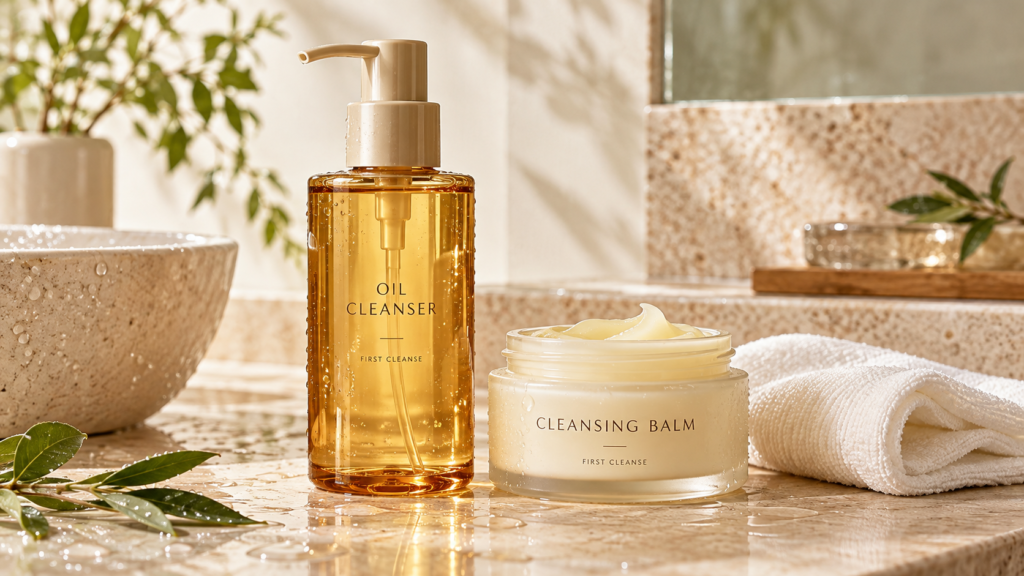
The first step is oil based: a liquid cleansing oil, solid cleansing balm or another makeup-removing format. Oil-soluble emollients and surfactants help lift makeup, sebum and resistant cosmetic films so they can be rinsed away. The second step is a water-based gel, cream or foaming cleanser chosen for the user’s skin type and tolerance.
The two cleansers do different jobs, but they do not need to be aggressive. The American Academy of Dermatology recommends washing with a gentle, non-abrasive cleanser, using lukewarm water and applying cleanser with the fingertips. That advice matters more than the number of cleansing steps. See the AAD’s face-washing guidance.
Double cleansing is not a medical treatment and it is not a requirement for having healthy-looking skin. Think of it as a flexible removal method for nights when one mild wash does not handle everything on the face.
Do you actually need to double cleanse?
| Situation | Reasonable approach | Why |
|---|---|---|
| Long-wear foundation, waterproof eye makeup or resistant sunscreen | Oil cleanser or balm, then a gentle water cleanser | The first step loosens the film so the second step requires less rubbing. |
| Light sunscreen, no makeup and comfortable skin | One well-chosen cleanser may be enough | A second wash adds no value if the first already removes residue. |
| Very dry, reactive or over-exfoliated skin | Use the shortest routine that cleans comfortably | More washing can increase tightness and irritation. |
| Very oily skin | Double cleanse only when there is something substantial to remove | Trying to strip away all oil can leave skin uncomfortable. |
| After exercise without makeup | A gentle single cleanse is often sufficient | Sweat does not automatically require an oil cleanser. |
The practical test is the result: after rinsing, the skin should feel clean but not squeaky, stiff or coated. A pale trace of foundation on a clean towel can suggest incomplete removal, but repeatedly wiping and scrubbing to chase a perfectly bare feel can be counterproductive.
Cleansing oil vs cleansing balm
| Feature | Cleansing oil | Cleansing balm |
|---|---|---|
| Format | Fluid oil in a pump bottle | Solid or sorbet-like product in a jar or tube |
| Best practical fit | Fast spreading over the face; convenient for frequent makeup removal | Controlled application; useful for travel and targeted massage |
| Texture | Slippy and lightweight to rich, depending on the oil blend | Cushioned and dense at first, then melts with contact |
| Main trade-off | Can run into the eyes or down the wrist if over-dispensed | Jar formats need clean, dry handling and may feel heavier |
| Removal | Should emulsify with water according to the label | Should melt, emulsify and rinse according to the label |
Neither format is automatically better for oily, dry or acne-prone skin. The complete formula, fragrance level, rinsing behavior and the user’s technique matter more than the name on the front. A clear rinse and comfortable finish are more useful selection criteria than claims such as pore vacuum, detox or deep purification.
How to double cleanse step by step
1. Start with dry hands and a dry face when the label directs it
Many oils and balms are designed to contact makeup before water is added. Follow the product directions because some micellar or hybrid products work differently. Dispense enough to spread without dragging the skin; more product is not always more effective.
2. Massage briefly and gently
Spread the first cleanser over makeup and sunscreen with light fingertip pressure. Give extra attention to the hairline, sides of the nose and jaw, where cosmetic films can remain. Long massage sessions are not necessary. Avoid pulling the eyelids and stop if the eyes sting.
3. Emulsify and rinse
Add a small amount of lukewarm water so the oil or balm turns milky if the formula is designed to emulsify. Rinse thoroughly. Hot water does not improve cleansing and can make dry or reactive skin feel worse.
4. Follow with a mild water-based cleanser
Use a gel, cream or low-foam cleanser that matches the skin’s needs. The purpose is to remove leftover product and everyday residue, not to create a squeaky finish. Our Arencia Fresh Green Rice Mochi Cleanser analysis shows how texture and particulate ingredients can change the cleansing experience even within one category.
5. Pat dry and continue with a simple routine
After cleansing, apply a treatment only when needed, then moisturizer. The AAD’s basic order is cleanse, apply medication or treatment, then moisturizer and/or sunscreen. See its product-order guidance. Our Korean skincare routine order guide explains how optional toner and serum layers fit around that core.
Adjusting double cleansing by skin type
Oily or acne-prone skin
An emulsifying oil cleanser can remove sunscreen and makeup without relying on harsh rubbing, but double cleansing itself does not treat acne. Choose a first cleanser that rinses clean and a second cleanser that does not leave the face tight. Avoid adding an exfoliating cleanser, strong toner and several acne actives on the same night. Persistent or painful acne deserves professional assessment.
Dry or dehydrated skin
Use two steps only when needed. A balm or richer oil may feel more cushioned, but the final result depends on the formula. Keep the second cleanse brief and consider a cream cleanser. Follow promptly with moisturizer while the skin is still comfortable.
Sensitive or reactive skin
Prioritize fragrance-free or low-fragrance options, short contact time and minimal rubbing. Patch-test unfamiliar products and introduce only one cleanser at a time. If a single cleanser removes everything, there is no prize for adding another.
Combination skin
Use the same gentle base method across the face, but spend less time massaging areas that are already dry. A lighter second cleanser can be used without repeatedly washing the T-zone.
Common double-cleansing mistakes
- Using the method every morning: most people do not need an oil cleanser after sleeping.
- Massaging for ten minutes: longer contact and friction do not guarantee cleaner pores.
- Using very hot water: lukewarm water is a safer default.
- Pairing two strong cleansers: an intense first step plus a stripping foam can leave skin tight.
- Skipping emulsification: oil and balm cleansers designed to emulsify rinse more cleanly when water is added gradually.
- Treating residue as proof of toxins: cleansers remove surface material; detox language is usually marketing shorthand.
- Expecting permanent pore shrinkage: cleansing can improve the look of congestion and surface residue, but it cannot erase normal pore structure.
How to read cleansing claims
In the United States, products intended to cleanse or beautify are generally cosmetics. FDA says cosmetic labeling claims must be truthful and not misleading, while claims to treat disease or affect the structure or function of the skin may make a product a drug. See the FDA’s cosmetics labeling claims guidance.
That distinction is useful when reading dramatic promises. A cleansing oil may remove makeup, help the skin feel softer and reduce visible surface residue. Those are reasonable cosmetic roles. Claims that a cleanser cures acne, permanently changes pores or rebuilds collagen require a different level of evidence and regulatory context.
Shopping checklist
- Choose the first-cleanser format you will use consistently.
- Check whether the product is designed for dry-face application and emulsification.
- Look for clear regional directions and a current ingredient list.
- Consider fragrance and essential-oil exposure if your skin is reactive.
- Make sure the second cleanser is gentle enough for consecutive use.
- Avoid duplicate exfoliating steps on nights when the skin feels sensitive.
- Judge success by clean, comfortable skin rather than a squeaky sensation.
Final verdict
Korean double cleansing is most useful as an evening removal strategy, not a universal commandment. Use a cleansing oil or balm when makeup, resistant sunscreen or a heavy cosmetic film would otherwise require repeated rubbing. Follow with a gentle water-based cleanser, keep the contact time reasonable and simplify whenever skin becomes tight or irritated.
The best routine is the one that removes the day with the least unnecessary effort. Some nights that means two cleansers. Other nights, one careful cleanse is the more intelligent choice.
Editorial note: This guide uses current guidance from the American Academy of Dermatology and the U.S. Food and Drug Administration. It is educational editorial content, does not claim personal-use testing, and does not diagnose or treat a medical condition.