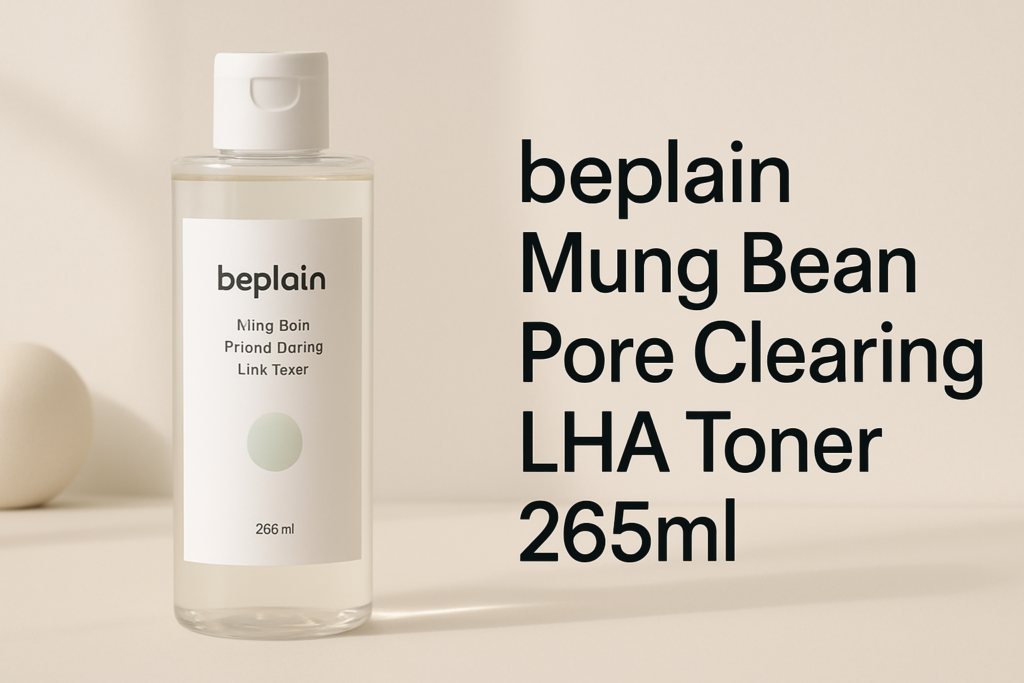
Updated October 5, 2026. Editorial verdict: The beplain Mung Bean Pore Clearing LHA Toner is an interesting Korean toner for shoppers who want a lightweight, watery step aimed at surface buildup and the look of congested pores without committing to a high-strength acid exfoliant. Its most notable exfoliating ingredient, capryloyl salicylic acid—also called LHA—is listed at 10ppm, or 0.001%, according to the brand’s Korean ingredient disclosure. That is a very small amount, so expectations should remain measured.
Quick verdict
- Best for: Combination, oily or balanced skin that prefers light hydration and mild pore-care support.
- Texture: Watery and lightweight by product format and ingredient structure.
- Main appeal: A large 265ml bottle combining humectants, mung bean extract, LHA and gluconolactone.
- Main limitation: The exfoliating ingredients appear low in the published formula, so this is not a substitute for a strong BHA or professional treatment.
- Bottom line: A sensible introductory toner for gradual routine-building, provided you do not layer it aggressively with other exfoliants.
Why this beplain toner is receiving attention
beplain is a Korean skincare brand with a recognizable mung bean range. Its official Korean store currently lists the Mung Bean Pore Clearing LHA Toner as a 265 ml toner for all skin types, with a formula combining humectants, mung bean extracts, LHA, gluconolactone and hyaluronic acid forms. This makes it relevant to shoppers seeking a gentler pore-care format rather than a high-strength acid toner. (beplain official product page)
The official product information identifies South Korea as the country of manufacture and recommends using the toner after cleansing, either with a cotton pad or by spreading it directly over the face and neck. Those details confirm the product format and intended use; they do not prove that it will visibly change pores for every user. (beplain official specifications)
The product’s positioning is straightforward: remove some of the feel of post-cleansing buildup, provide light moisture and support a smoother-looking complexion. The formula is less dramatic than many viral “pore tightening” products, which is part of its appeal. It is a daily-routine format rather than a peel or intensive mask.
Product overview
- Full name: beplain Mung Bean Pore Clearing LHA Toner 265ml
- Brand: beplain
- Product type: Facial toner with mild exfoliating and hydrating positioning
- Country of manufacture: South Korea, according to the official Korean product information
- Size: 265ml
- Brand-listed skin suitability: All skin types
- Published formula: Water, glycerin, butylene glycol, sorbitol, humectants, botanical extracts, LHA, gluconolactone, hyaluronic acid forms and multiple peptides
Formula concentrations and ingredient names in this review follow the brand’s current Korean disclosure, which lists mung bean extract at 200 ppm and capryloyl salicylic acid at 10 ppm. (Official ingredient disclosure)
Key ingredients and what each does
LHA: capryloyl salicylic acid
Capryloyl salicylic acid is commonly known as LHA. It is a salicylic-acid-related exfoliating ingredient used in pore-care products. In this formula, the official ingredient disclosure lists it at 10ppm, equivalent to 0.001%. That concentration is important context: the presence of LHA gives the product an exfoliating identity, but the listed amount suggests a deliberately restrained approach.
Shoppers should not assume that a toner containing LHA will automatically clear visible blackheads or dramatically change pore appearance. Pores cannot be permanently erased by skincare. At best, consistent cleansing and exfoliation may make the surface look smoother or reduce the appearance of buildup for some users.
Gluconolactone
Gluconolactone is a polyhydroxy acid, or PHA. PHAs are generally used in formulas designed to exfoliate more gradually while also contributing some water-binding properties. Its inclusion gives the toner a second exfoliating component, although the brand does not publish the concentration.
Because the formula combines more than one exfoliating-related ingredient, sensitive users should still introduce it slowly. “Gentle” is not the same as irritation-proof, and individual tolerance varies.
Mung bean extract
Mung bean extract is central to beplain’s product identity. The official ingredient list identifies mung bean extract at 200ppm, along with mung bean seed extract and mung bean sprout extract at lower listed levels. In practical terms, it helps define the botanical story of the product, but the ingredient list alone cannot establish a specific pore-clearing or oil-control result.
Glycerin, butylene glycol, sorbitol and propanediol
These are humectants and solvents commonly used to help a toner spread and provide lightweight hydration. They are likely responsible for much of the formula’s comfortable, non-cream-like moisture profile. Humectants attract and hold water near the skin’s surface, but they work best when followed by a moisturizer suited to the user’s skin and climate.
Three forms of hyaluronic acid
The published list includes hyaluronic acid, hydrolyzed hyaluronic acid and sodium hyaluronate. Different forms can vary in molecular size and behavior, but the practical role here is hydration rather than exfoliation. They make the toner more balanced than a purely acid-focused liquid.
Papain, apple and plant extracts
The formula also contains papain, apple extract, chestnut shell extract, persimmon leaf extract and several sprout extracts. Papain is an enzyme associated with exfoliating formulations, while the plant extracts contribute to the product’s botanical positioning. Their individual concentrations and real-world contribution are not fully disclosed, so they should be viewed as supporting ingredients rather than guaranteed treatment actives.
Peptides
The ingredient list includes acetyl hexapeptide-8, copper tripeptide-1 and a range of other peptides. Peptides are often included in skincare for conditioning or appearance-focused firming claims. Here, they are positioned within a watery pore-care toner, but their low placement in the ingredient list means shoppers should not buy this product primarily as a peptide treatment.
Texture and finish
This is a watery toner rather than a milky lotion or gel. Water and humectants appear near the beginning of the ingredient list, and the product’s official directions describe applying it with a cotton pad or spreading it directly over the skin. That points to a light, fast-spreading format suitable for layering.
The expected finish is fresh rather than rich. It should suit people who dislike heavy, emollient toners, particularly in humid weather or under sunscreen. However, a watery texture does not guarantee that the skin will feel fully moisturized. Dry or dehydrated users may need a hydrating serum and moisturizer afterward.
The formula list does not show added fragrance or essential oils. That may appeal to shoppers who prefer a less perfumed routine, although the absence of those ingredients does not guarantee that every reactive complexion will tolerate the product.
Best and poor fits by skin type
Best fits
- Combination skin: The lightweight format can add hydration without the weight of a rich toner, while the exfoliating positioning may suit areas prone to visible buildup.
- Oily skin: This may be a comfortable option for shoppers who want a watery toner rather than an oil-rich product. It should not be treated as a replacement for a cleanser or a proven acne treatment.
- Balanced skin: The formula can function as an occasional or gradual exfoliating toner if the rest of the routine is simple.
- Texture-focused routines: Users concerned with a rough-feeling surface may appreciate a low-intensity exfoliating step, provided they introduce it carefully.
Potentially poor fits
- Very dry skin: The toner may feel too light on its own and may not provide enough emollient comfort.
- Highly reactive skin: LHA, gluconolactone, papain and other botanical ingredients may be too much when the skin barrier is already unsettled.
- Users already applying several acids: Adding another exfoliating product can make a routine unnecessarily complicated.
- Those expecting dramatic pore reduction: No toner can permanently shrink pores, and the formula does not provide evidence for a transformational result.
How to use it
After cleansing, apply a moderate amount to the face and neck. The official directions allow two approaches: dispense it onto a cotton pad and sweep along the skin, or apply it directly with clean hands and gently spread it until absorbed.
For a first use, begin two or three evenings per week rather than applying it multiple times daily. If the skin remains comfortable after several weeks, some users may prefer more frequent use. There is no need to scrub with the cotton pad; pressure and friction can undermine the purpose of a gentle routine.
Do not introduce it on the same night as a retinoid, strong exfoliating serum or abrasive scrub until you understand your tolerance. Apply moisturizer afterward, and use sunscreen during the day. Stop if persistent stinging, redness, swelling or itching develops.
Strengths
- Large 265ml format suitable for regular toner use.
- Watery texture that should layer easily with serums and creams.
- Combines hydration-focused humectants with LHA and gluconolactone.
- Includes mung bean extract, giving the product a clear Korean botanical identity.
- Official ingredient disclosure provides unusually useful concentration details for mung bean extract and LHA.
- Free from the heavy fragrance profile some shoppers avoid in exfoliating products, based on the published ingredient list.
Limitations
- The published LHA level is only 0.001%, so the exfoliating effect may be subtle.
- The brand does not publish the concentration of gluconolactone, papain or most botanical extracts.
- “Pore clearing” is a cosmetic positioning, not a promise that clogged pores will disappear.
- The product may be too light for dry skin unless paired with richer hydration.
- Its multi-ingredient formula may not be ideal for users who prefer very short ingredient lists.
How it compares with alternatives
| Product | Best suited to | How it differs |
|---|---|---|
| beplain Mung Bean Pore Clearing LHA Toner | Light hydration plus gradual pore-care support | Uses a very low listed level of LHA with PHA, mung bean extract and humectants. |
| beplain Mung Bean Pore Clearing Filter Pad | Shoppers who prefer a pre-soaked pad format | More convenient for targeted wiping or short contact, but potentially more friction depending on use. |
| COSRX BHA Blackhead Power Liquid | Users seeking a more established BHA-focused exfoliating step | A stronger, more treatment-oriented exfoliating profile; less suitable for cautious beginners. |
| Round Lab 1025 Dokdo Toner | Simple daily hydration without a pore-care focus | Generally positioned as a hydrating toner rather than an exfoliating formula. |
| Isntree Chestnut BHA 2% Clear Liquid | Experienced users targeting visible congestion | More clearly centered on BHA exfoliation and likely a poor first choice for very sensitive skin. |
Buyer checklist
- Confirm that the seller is an authorized retailer or the official beplain store.
- Check the product name carefully: the Mung Bean line includes cleansers, pads, masks and serums with similar packaging.
- Look for the 265ml size if you want the standard toner format.
- Review the ingredient list on the package because formulas and translations can change by market.
- Do not buy it solely for the word “LHA”; the published concentration is very low.
- If your routine already includes acids or retinoids, plan where this toner fits before purchasing.
- Patch-test first if your skin is reactive or currently feels irritated.
Final assessment
The beplain Mung Bean Pore Clearing LHA Toner is best understood as a mild, hydrating Korean toner with a pore-care angle—not as a high-powered exfoliant. Its formula is most compelling for combination or oily users who want a watery step and prefer gradual routine changes. The combination of humectants, hyaluronic acid forms, mung bean extract, gluconolactone and a very low level of LHA gives it a balanced concept.
Its biggest strength is also its clearest limitation: the formula appears restrained. That may make it easier to introduce than a strong acid liquid, but it also means visible changes may be modest and slow. For global beauty shoppers, the product makes sense when the goal is lightweight maintenance and smoother-feeling skin—not instant pore erasure.
Transparent editorial note: This article is based on the official beplain product information, the published ingredient list and current Korean beauty retail attention. No independent laboratory testing, clinical testing, personal application test or dermatologist assessment was performed for this review. Ingredient functions describe common cosmetic roles and should not be read as medical claims or guarantees of individual results.