Updated October 6, 2026.
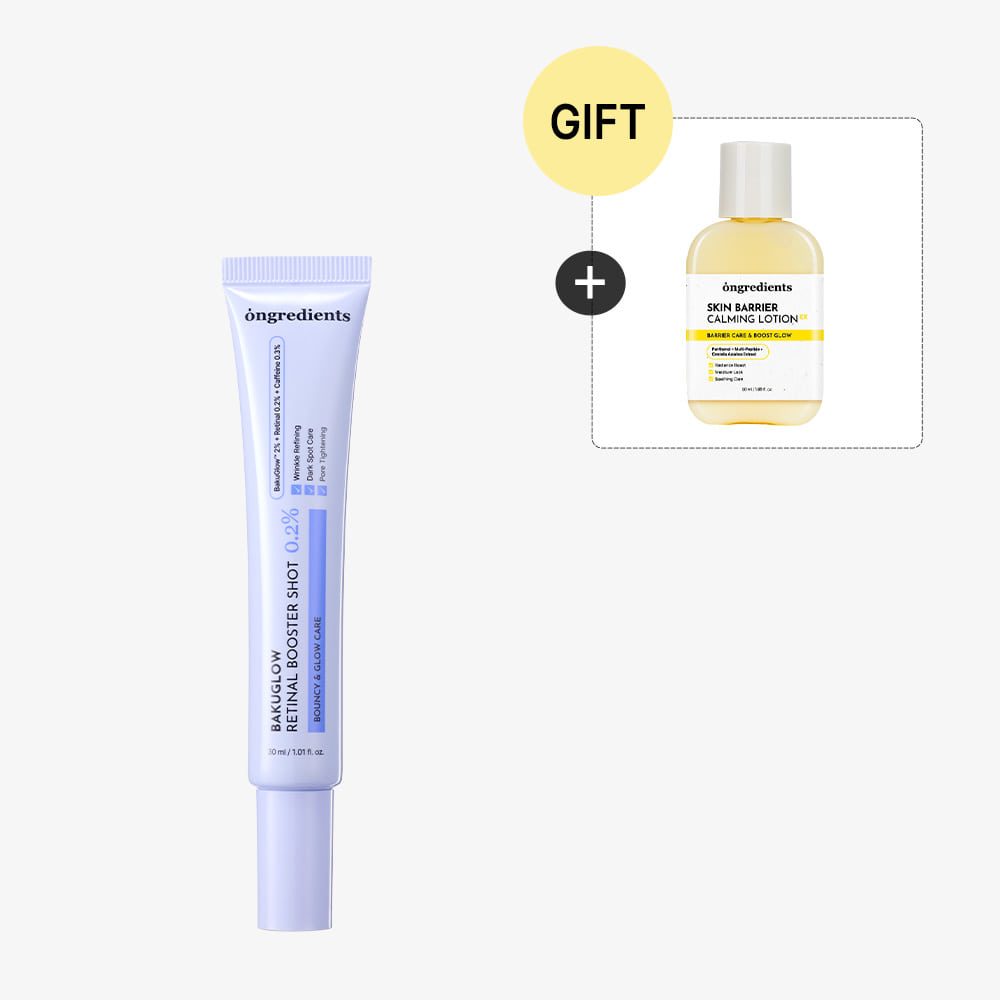
Ongredients Bakuglow Retinal Booster Shot 0.2% is a newly listed Korean retinal serum. Ongredients’ official Korean product page identifies the 0.2% version, while Olive Young Korea’s official product listing confirms the 30ml size and NEW status.
Its appeal is easy to understand: the formula combines a clearly stated 0.2% retinal concentration with niacinamide, bakuchiol, several forms of hyaluronic acid, ceramide NP, cholesterol and peptide ingredients. Ongredients also markets the serum around a “90,000-shot” micro-spicule or micro-needle concept.
That last point needs careful interpretation. The presence and purpose of the micro-spicule technology are brand claims, not proof that the product delivers a clinical treatment effect. The more independently assessable part of the product is its ingredient list, packaging information and usage guidance.
Quick verdict
Worth considering if: you already tolerate retinoids and want a multi-active Korean serum with a substantial retinal headline concentration.
Approach cautiously if: you are new to retinal, have a reactive barrier, or dislike formulas designed around a prickling or “booster” sensation.
Bottom line: Ongredients Bakuglow Retinal Booster Shot 0.2% looks more ambitious than a basic beginner retinal. Its supporting hydrators and barrier-oriented ingredients are useful, but they do not remove the need for a slow introduction, sunscreen and careful pairing.
Product overview
Ongredients is operated by the South Korean company Powerplayer, as identified in the footer of the official brand listing. The product is sold in a 30ml format according to Olive Young Korea.
The official Ongredients page currently presents the serum in a promotional listing with a 50ml Skin Barrier Calming Lotion EX gift, while Olive Young lists the 30ml serum separately. Promotions can change, so check the exact set contents, product size and current ingredient panel before purchasing.
The formula’s central active is retinal, also called retinaldehyde. Retinal is a vitamin A derivative that sits closer to retinoic acid than retinol in the conversion pathway used by skin. That does not make every retinal product equally strong, because the final experience depends on concentration, stability, vehicle, packaging and individual tolerance. However, a stated 0.2% retinal level is not a detail to treat casually.
Key ingredients and what each does
Retinal
Retinal is the formula’s primary active and the reason this product belongs in the retinoid category. Cosmetic retinal products are commonly used to improve the appearance of uneven texture, dullness and visible signs of skin aging over time. Irritation is possible, especially when frequency increases too quickly.
The brand presents 0.2% as a major selling point. It is important to distinguish that label claim from a guarantee of results. A concentration printed in a product name does not reveal the complete delivery system, stability testing or how much active remains by the end of the product’s usable life.
Niacinamide
Niacinamide appears relatively high in the published ingredient list. It is a versatile cosmetic ingredient associated with barrier support, oil-balance care and the appearance of uneven tone. In this formula, it gives the serum a second broad skincare focus rather than leaving retinal to work alone.
Some people find niacinamide comfortable even in active routines, while others experience warmth or redness with higher-strength formulas. If your skin reacts to niacinamide products, patch testing remains sensible.
Hyaluronic acid and humectants
The formula includes sodium hyaluronate, hydrolyzed hyaluronic acid, hyaluronic acid, hydroxypropyltrimonium hyaluronate, sodium acetylated hyaluronate, hydrolyzed sodium hyaluronate, sodium hyaluronate crosspolymer and potassium hyaluronate. These are different forms of water-binding ingredients used to support a hydrated, cushioned skin feel.
Glycerin, propanediol, butylene glycol, trehalose, sodium lactate and polyglutamic acid add further humectant support. This is useful because retinoid routines often become uncomfortable when the rest of the routine is too dry or stripped.
Bakuchiol
Bakuchiol is included later in the ingredient list and is part of the product’s “Baku” naming concept. It is a plant-derived cosmetic ingredient frequently used in formulas positioned around smoother-looking skin and visible firmness. The list does not state its percentage, so its exact contribution cannot be judged from the product name alone.
Bakuchiol should not be treated as a way to cancel out retinal’s irritation potential. The serum remains a retinal product first.
Ceramide NP, cholesterol and related lipids
Ceramide NP and cholesterol appear in the lower half of the ingredient list. They are familiar skin-identical lipids used in barrier-focused skincare. Their inclusion is a positive design choice for a retinal formula, although the ingredient list does not provide enough information to say that the product recreates a complete barrier-lipid ratio.
Hydrogenated lecithin and rapeseed sterols also contribute to the formula’s emollient and lipid-supporting profile. These ingredients may help balance the more active positioning, but they do not make the serum automatically suitable for compromised skin.
Peptides and caffeine
Palmitoyl tripeptide-1 and palmitoyl tetrapeptide-7 appear near the end of the published list. These signal peptides are commonly used in cosmetic formulas aimed at the appearance of firmness and smoother-looking skin. Because their concentrations are not disclosed, they should be viewed as supporting ingredients rather than the main reason to buy the product.
Caffeine is also included. In topical skincare it is often used in formulas designed to make the eye area or skin look more refreshed. The presence of caffeine does not establish a specific tightening or de-puffing result.
Texture and finish
The ingredient list suggests a water-based serum with humectants, lightweight glycols, silicone-free emollient components and a small amount of oil-based support. The formula also contains macadamia seed oil and sea buckthorn oil, so it is not simply a bare watery essence.
Ongredients positions the product as a lightweight serum that can be spread in a small amount. However, a product built around a micro-spicule concept may feel different from a conventional retinal emulsion. A temporary prickling sensation is a reasonable possibility based on the brand’s positioning, but individual experience can vary significantly.
Expect a hydrated rather than powder-matte finish. Skin that is oily may prefer a small amount followed by a light moisturizer, while dry skin may want a separate barrier cream on top.
Best and poor fits by skin type
Best fits
- Normal or combination skin: The layered humectants and moderate emollient support may offer a balanced starting point for people already familiar with active serums.
- Oily skin: The serum format may be easier to fit into a routine than a rich retinal cream, although the lipid ingredients can still feel more substantial than a water gel.
- Experienced retinoid users: The clearly stated 0.2% retinal positioning is more relevant to users who already know how their skin responds to vitamin A products.
- Texture-focused routines: Retinal, niacinamide and hydration-supporting ingredients make this a logical option for shoppers focused on dullness and uneven-looking texture.
Poorer fits
- Very reactive or currently irritated skin: The retinal level and micro-spicule positioning may be too ambitious during a flare-up or barrier disruption.
- Retinoid beginners: A lower-strength retinal or retinol product may be easier to introduce and assess.
- Fragrance-sensitive shoppers: The published ingredient list does not show parfum, which is encouraging, but always verify the packaging because formulas can change.
- Anyone expecting instant pore reduction: No topical serum can permanently shrink pores. Any early “tightening” impression may reflect hydration, film-forming ingredients or temporary surface effects.
How to use it
Use Ongredients Bakuglow Retinal Booster Shot 0.2% at night. Apply a small amount to clean, completely dry skin, then follow with moisturizer. If your skin is sensitive, apply moisturizer before the serum or use a moisturizer sandwich method.
For a cautious introduction, begin once or twice weekly for two weeks. If your skin remains comfortable, move to every third night, then gradually increase only if needed. There is no advantage to forcing nightly use when your skin is already dry, tight, stinging or visibly peeling.
Keep the rest of the evening routine simple at first. Avoid using it in the same routine as exfoliating acids, strong peeling products or another retinoid. The next morning, use broad-spectrum sunscreen and reapply as appropriate for your exposure.
Retinoid products are generally approached cautiously during pregnancy and breastfeeding. Anyone who is pregnant, trying to conceive or nursing should discuss retinoid use with an appropriate healthcare professional rather than relying on marketing language.
Strengths
- Clear active positioning: The product name states 0.2% retinal instead of hiding the headline active behind vague “retinal complex” language.
- Well-supported formula concept: Hydrators, niacinamide, lipid ingredients and peptides give the serum more cushioning than a minimalist retinoid formula.
- No fragrance listed: The published ingredient list does not include parfum or a conventional drying alcohol.
- New Korean format: The micro-spicule booster concept gives the product a distinctive identity in a crowded retinal category.
- International interest: Its appearance on Olive Young Korea and global K-beauty retail channels makes it more accessible than a purely local launch.
Limitations
- The micro-spicule claims are not the same as clinical proof: “90,000 shots” is a brand-promoted product feature, not an independently verified treatment outcome.
- Active concentration is not the whole formula: The stated retinal percentage does not tell shoppers how stable the retinal remains during storage or after opening.
- Potential irritation: A 0.2% retinal serum is not automatically beginner-friendly, especially when paired with a delivery concept intended to create a noticeable sensation.
- No independently verified performance testing was identified for this review: There is not enough evidence to promise wrinkle reduction, pore tightening or improved firmness.
- Promotional listings may vary: The official brand page currently includes a gifted lotion, while Olive Young lists the 30ml serum separately. Check what is included before ordering.
Buyer checklist
- Confirm that the product is the 30ml Bakuglow Retinal Booster Shot 0.2%, not another Bakuglow item.
- Check whether the retailer is authorized and whether the seal, batch information and expiration details are visible.
- Review the current ingredient list on the box because cosmetic formulas can change.
- Do not buy it solely because “micro-spicule” sounds more advanced. Decide first whether your skin can tolerate retinal.
- Start slowly and budget for a moisturizer and daily sunscreen.
- Compare the total delivered cost, especially when buying from overseas retailers.
Alternatives and comparison
| Product or approach | How it compares | Better choice for |
|---|---|---|
| Ongredients Bakuglow Retinal Booster Shot 0.2% | Higher-intensity retinal positioning with hydration, lipids, peptides and a brand-promoted micro-spicule concept. | Experienced retinoid users wanting a new Korean active-serum format. |
| SOME BY MI Retinal Intense Reactivating Serum | A more conventional Korean retinal serum concept, generally easier to understand as a standard leave-on treatment. | Shoppers who prefer a familiar serum format without a booster-shot identity. |
| Isntree Hyper Retinol EX 1.0 Advanced Serum | Another active-focused Korean treatment option with a different retinoid strategy and formula profile. | Users comparing retinoid products by active system rather than micro-spicule marketing. |
| A gentle retinal or retinol serum | Usually the safer starting point when tolerance is unknown, even if visible progress is slower. | Beginners, dry skin and easily irritated skin. |
| A barrier serum with ceramides and hyaluronic acid | Does not replace retinal, but can help simplify and stabilize a routine before adding a stronger active. | Compromised or over-exfoliated skin. |
Final assessment
Ongredients Bakuglow Retinal Booster Shot 0.2% is a legitimate new Korean product with a clearly identifiable formula concept and meaningful early attention in Korea. Its strongest case is not the dramatic “booster shot” language. It is the combination of a stated retinal concentration with a substantial hydration and barrier-supporting ingredient base.
That combination still requires realistic expectations. The serum may be interesting for experienced retinoid users, but the 0.2% retinal claim and micro-spicule positioning make it a poor candidate for rushing into nightly use. Beginners may be better served by a lower-strength product, while sensitive-skin shoppers should prioritize comfort over novelty.
Editorial note: Updated October 6, 2026 using the official Ongredients listing and Olive Young Korea product page. This article evaluates published product and ingredient information; it does not report personal testing, laboratory verification, clinical outcomes or independent sales rankings. Brand claims about micro-spicules, delivery, glow, pores and firmness are presented as marketing claims rather than established results.