Updated October 18, 2026.
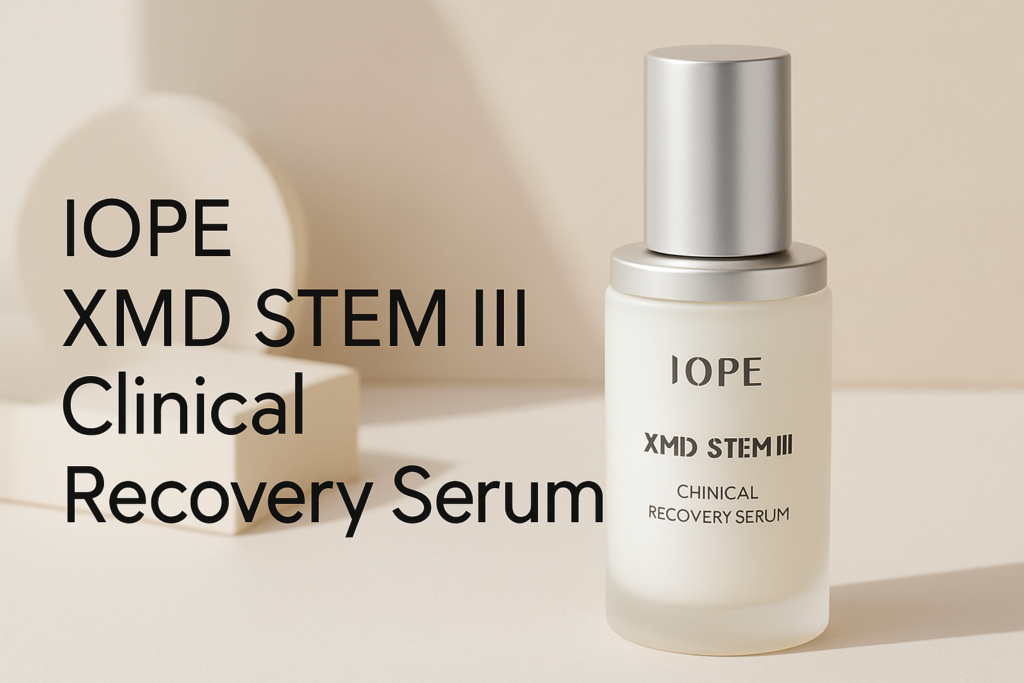
Editorial verdict: IOPE XMD STEM III Clinical Recovery Serum is a polished, hydration-first treatment serum built around the current Korean PDRN trend. Its strongest case is not that it recreates an injectable procedure, but that it combines humectants, niacinamide, soothing ingredients, lipids, and a small amount of hydrolyzed DNA in a streamlined formula designed for plumper-looking, smoother-feeling skin.
The official IOPE international product page lists the 30 mL serum, links shoppers to Sephora and publishes the full ingredient list, directions and brand-reported split-face study details. Those signals establish current international availability and the basis of IOPE’s claims; they do not prove universal popularity or superiority over another serum.
Quick verdict
Best for: Normal, dry, combination, or early-mature skin wanting a refined, non-exfoliating serum for hydration, visible plumpness, and a smoother finish.
Less ideal for: Shoppers seeking a high-strength retinoid, a simple low-cost hydrator, or a fragrance-free formula with no alcohol listed.
What stands out: A cosmetically elegant formula with niacinamide, betaine, allantoin, centella-derived compounds, cholesterol, hyaluronic acid, and hydrolyzed DNA.
Bottom line: Worth considering if you want the Korean PDRN conversation in a more complete serum formula. Do not buy it expecting the same result as an injectable PDRN or polynucleotide treatment.
Product overview
IOPE XMD STEM III Clinical Recovery Serum is a 30 mL facial serum positioned around the brand’s PDRN H.A.™ Liposome Complex. IOPE describes that complex as containing PDRN, micro-molecular hyaluronic acid, and an allantoin-based complex. The official product page lists target concerns including dryness, loss of firmness, visible pores, compromised-looking skin, and early signs of aging.
The formula is not built like a minimalist single-ingredient ampoule. Its ingredient list begins with water, butylene glycol, glycerin, dipropylene glycol, niacinamide, and betaine. It then adds emollients, silicones, hydrogenated lecithin, allantoin, centella-associated compounds, cholesterol, adenosine, hydrolyzed DNA, hyaluronic acid, peptide acetyl tetrapeptide-11, and antioxidant tocopherol. The current listed INCI should still be checked against the packaging because ingredient lists can change by market or production run.
IOPE’s U.S. launch materials describe the product as inspired by Korea’s professional PDRN treatment trend and list a $59 U.S. price at launch. That is a brand and distributor claim, not independent proof that the serum duplicates a clinic treatment.
Key ingredients and what each does
PDRN H.A.™ complex and hydrolyzed DNA
The product’s marketing centers on PDRN H.A.™, but the published ingredient list identifies “hydrolyzed DNA” rather than providing a separate percentage for PDRN. That distinction matters. Consumers should not assume that the “92.3%” headline means the serum contains 92.3% pure PDRN. IOPE describes it as a 92.3% PDRN H.A.™ Liposome Complex, meaning the percentage refers to the brand’s named complex, not necessarily to isolated PDRN alone.
Most evidence discussed around PDRN comes from professional or medical delivery rather than ordinary leave-on cosmetics. A topical serum uses a different route, dose and vehicle, so the defensible expectation is narrower: hydration, surface smoothness and a fuller-looking finish from the complete formula, not the result of an injectable procedure.
Hyaluronic acid, glycerin, and betaine
These are the more familiar hydration drivers. Glycerin and betaine are water-binding ingredients that help the formula feel cushioned and reduce the dry, tight sensation associated with dehydrated skin. Hyaluronic acid is also included, although the product page does not state its concentration or molecular-weight distribution. IOPE describes its version as micro-molecular hyaluronic acid, but that is a brand-specific description rather than an independently verified measurement.
Niacinamide
Niacinamide appears relatively high in the INCI list, after the main solvents and before several supporting ingredients. It is widely used in cosmetics to support the appearance of uneven tone, dullness and a weakened-feeling barrier. The official page does not disclose its percentage, so the finished product should be judged as a complete formula rather than as a known high-strength niacinamide treatment.
Allantoin and centella-associated compounds
Allantoin is included in the formula and is commonly used in cosmetics for a conditioned, comfortable skin feel. The formula also contains asiaticoside, madecassic acid, and asiatic acid, which are compounds associated with Centella asiatica. Together, these ingredients support the product’s soothing and recovery-oriented positioning without turning the serum into a medical treatment.
Cholesterol, hydrogenated lecithin, and emollients
Cholesterol and hydrogenated lecithin give the formula a more barrier-conscious profile than a basic water-gel serum. Caprylic/capric triglyceride and dimethicone add slip and softness. These ingredients can make a serum feel more comfortable on dry or sensitized-feeling skin, but they also mean the product may feel richer than a very watery essence.
Adenosine and acetyl tetrapeptide-11
Adenosine is a familiar cosmetic ingredient used in formulas targeting the appearance of fine lines and loss of firmness. Acetyl tetrapeptide-11 is a signal peptide included near the end of the list. The presence of these ingredients adds to the formula’s anti-aging positioning, but their exact levels and independent contribution cannot be determined from the public INCI alone.
Texture and finish
IOPE does not publish a formal viscosity description, and TENCHOICE BEAUTY has not conducted laboratory texture testing for this article. Based on the ingredient structure, shoppers can reasonably expect a light-to-medium serum with noticeable slip rather than a thin, watery toner. Glycerin, betaine, polymers, dimethicone, and caprylic/capric triglyceride point toward a cushioned application with some surface smoothing.
The likely finish is hydrated and softly dewy, especially when layered over toner and followed by moisturizer. On oily skin, the emollient and silicone components may feel more present than a minimalist gel serum. On dry skin, that same structure may help the product feel less evaporative and more comfortable through the day.
Alcohol appears in the published ingredient list. It is not listed at the top, but people who are highly reactive to alcohol-containing formulas should patch test rather than assuming that the product will feel universally calming. There is no fragrance listed in the published INCI, although packaging remains the final authority.
Best and poor fits by skin type
Best fits
- Normal skin: A good match if you want one serum that combines hydration, visible glow, and a more substantial skin feel.
- Dry skin: The humectants, emollients, dimethicone, lecithin, and cholesterol may make it more satisfying than a simple watery hyaluronic acid serum.
- Combination skin: Use one pump on the whole face or apply more selectively to drier areas. The formula may be comfortable without requiring a heavy cream in humid weather.
- Early-mature skin: The formula is relevant for shoppers focused on hydration, surface smoothness, and a fuller-looking finish rather than aggressive exfoliation.
- Post-active routine users: If your routine already includes retinoids or exfoliating acids, this serum may be appealing as a non-exfoliating hydration step. Introduce it separately so you can identify any irritation.
Poorer fits
- Very oily skin: You may prefer a lighter gel serum, particularly in hot or humid conditions.
- Extremely reactive skin: The inclusion of alcohol means patch testing is sensible, even though the formula also contains soothing and barrier-supportive ingredients.
- Ingredient minimalists: This is not a short formula. It contains multiple humectants, emollients, texture agents, botanical-derived compounds, a peptide, and a DNA-derived ingredient.
- Shoppers seeking strong correction: This is not a retinoid, exfoliating acid, vitamin C treatment, or pigment-focused active serum. Its visible effect is more likely to be hydration and surface refinement.
How to use IOPE XMD STEM III Clinical Recovery Serum
IOPE recommends applying one to two pumps after cleansing and toning, gently massaging until absorbed, and using the serum morning and night.
For a simple routine, apply it after cleanser and toner, then follow with moisturizer. In the morning, finish with broad-spectrum sunscreen. At night, place it after water-based steps and before a cream or sleeping mask if you need additional moisture.
If you use retinoids, exfoliating acids, strong vitamin C, or prescription treatments, introduce the serum on alternate days first. The formula is not marketed as an exfoliant, but layering several new products at once makes it difficult to identify the cause of irritation.
Strengths
- Uses a broad supporting formula instead of relying only on the PDRN trend.
- Includes familiar hydration and comfort ingredients high in the ingredient list.
- Offers a more substantial texture than many watery Korean ampoules.
- Has an official international product page with a full ingredient list and usage instructions.
- Is available through recognizable global channels, including Sephora and Olive Young’s U.S. platform.
Limitations
- The brand’s headline clinical data come from a small, brand-reported split-face study of 33 participants over four weeks. The official page says the comparison involved 1 cc of PDRN treatment on one side and the product used twice daily on the other. That is interesting, but it is not the same as an independent, peer-reviewed trial demonstrating equivalence to an injectable procedure.
- The product does not disclose the percentage of hydrolyzed DNA or the amount of hyaluronic acid in the finished serum.
- “92.3% PDRN H.A.™ Liposome Complex” should not be read as “92.3% pure PDRN.”
- Alcohol is present in the published INCI, which may matter to highly reactive users.
- The 30 mL size is smaller than many Korean serums, so value depends on how much you use and whether you want the formula’s specific texture and positioning.
Buyer checklist
- Confirm that the product name reads XMD STEM III Clinical Recovery Serum, not the matching essence toner, cream, or emulsion.
- Check the size. The international IOPE page and Olive Young U.S. listing identify the serum as 30 mL.
- Compare the current ingredient list with the packaging before use.
- Do not confuse the brand’s PDRN H.A.™ complex percentage with a disclosed pure-PDRN percentage.
- Patch test if you are sensitive to alcohol-containing skincare.
- Buy from IOPE, Sephora, Olive Young, or another authorized retailer to reduce the risk of old, counterfeit, or incorrectly stored stock.
Alternatives and comparison
| Product | Best for | How it differs |
|---|---|---|
| IOPE XMD STEM III Clinical Recovery Serum | Plumpness, hydration, and a treatment-inspired experience | More complex and cushiony than a basic hydrating serum; includes hydrolyzed DNA, niacinamide, centella compounds, and barrier-supportive lipids. |
| Torriden DIVE-IN Low Molecular Hyaluronic Acid Serum | Lightweight daily hydration | A simpler choice for shoppers prioritizing a watery, humectant-focused texture rather than PDRN positioning. |
| SKIN1004 Madagascar Centella Ampoule | Minimalist soothing care | Better suited to shoppers who want a short, centella-centered formula with less emphasis on anti-aging complexes. |
| IOPE Retinol RX 2% Reti-jection Serum | Retinoid-focused texture and firmness care | A more active and potentially more demanding option; it is not a direct substitute for the hydration-first XMD serum. |
For a broader decision between PDRN-positioned and hydration-focused formulas, see our Anua PDRN vs Torriden DIVE-IN comparison and PDRN skincare evidence guide.
Official source checked
- IOPE International: XMD STEM III Clinical Recovery Serum — size, ingredients, directions and brand-reported study details.
Transparent editorial note
This article is based on the official IOPE product page, IOPE and Amorepacific launch information, the Olive Young U.S. listing, the published ingredient list, and independent literature concerning topical PDRN and common cosmetic ingredients. Brand-reported clinical results are identified as brand claims. TENCHOICE BEAUTY did not independently test the serum, verify the company’s study data, measure its texture, or confirm a specific PDRN concentration.
Our practical conclusion is deliberately narrower than the product’s treatment-inspired language: IOPE XMD STEM III Clinical Recovery Serum appears to be a well-constructed Korean hydrating and smoothing serum with a timely PDRN story. It may be worth choosing for its total formula, finish, and availability—not because topical skincare should be expected to reproduce an injectable procedure.