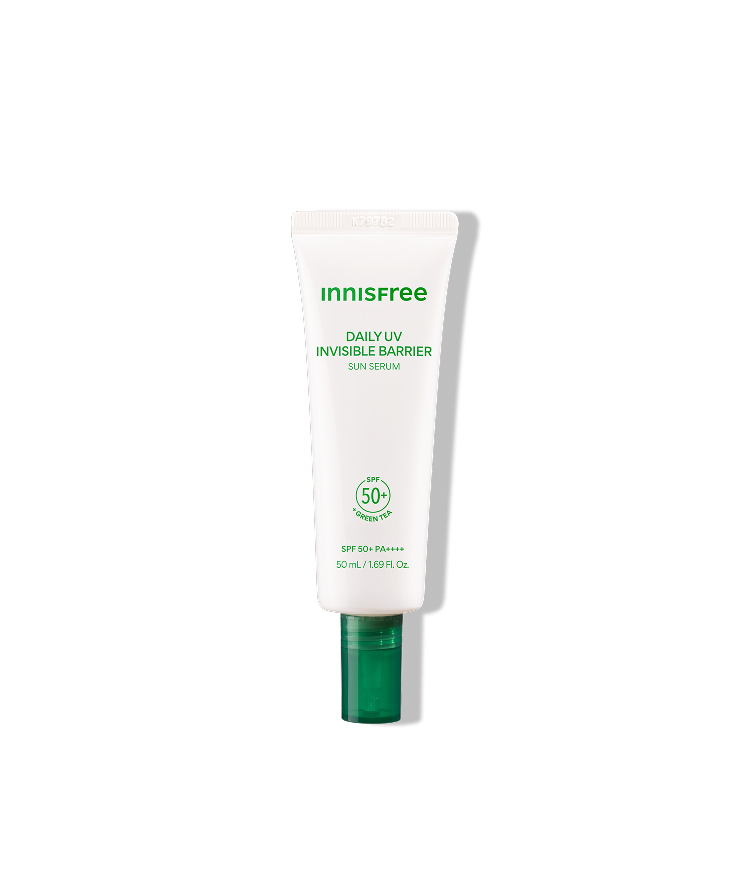
Updated October 5, 2026. Editorial verdict: innisfree’s Daily UV Moisture Barrier Sun Serum is a persuasive example of where Korean daily sun care is moving: less like a traditional sunscreen lotion and more like a lightweight morning skincare step. The formula is designed to combine UV protection with a fluid, moisturizing finish that can sit beneath makeup.
The Korean product is currently sold as the third-generation Daily UV Moisture Barrier Sun Serum, while the U.S. storefront uses the name Daily UV Invisible Barrier Sunscreen Serum Broad Spectrum SPF 47 with Green Tea. They share a serum-sunscreen concept, but market-specific names, claims and filter disclosures should be checked separately. (innisfree Korea product page; innisfree U.S. product page)
The main appeal is straightforward: a fresh, serum-like texture, green tea-derived ingredients, panthenol, madecassoside and hyaluronic-acid ingredients. The main caution is equally important: the Korean and overseas versions may use different names, claims and sun-protection labeling. Global buyers should confirm the exact market version before ordering.
Quick verdict
Best for: Normal, combination and mildly dry skin that prefers lightweight, dewy sunscreen under makeup.
Worth considering if: You dislike thick sunscreen textures and want hydration built into your morning SPF step.
Think twice if: You need a strongly matte finish, substantial water resistance, or a mineral-only sunscreen.
Bottom line: A modern Korean sunscreen-serum hybrid with a comfortable daily-use concept. Its biggest strength is texture and routine simplicity, not an unusually complex treatment formula.
Product overview
The Korean product is titled [3세대] 이니스프리 데일리 유브이 수분장벽 선세럼 50mL, which translates approximately as “third-generation Daily UV Moisture Barrier Sun Serum.” innisfree presents it as a dual-care product combining UV protection with moisture-barrier-focused skincare. (Official Korean listing)
The official Korean product page highlights green tea ceramide, rapid moisture absorption, a fresh finish and improved makeup adherence as brand-positioned benefits. These statements come from innisfree and its cited testing; they are not independent performance conclusions and should not be treated as proof that every user will have the same experience.
For international shoppers, the brand’s U.S. product page uses the name Daily UV Invisible Barrier Sunscreen Serum Broad Spectrum SPF 47 with Green Tea. (Official U.S. listing) That page identifies it as a chemical sunscreen with avobenzone, homosalate and octisalate, while the Korean product page uses Korean-market naming and presentation. This difference is normal for products sold across regulated markets, but it is a reason to inspect the label of the version you actually plan to purchase.
Key ingredients and what they do
Green tea and green tea-derived ingredients
Green tea is a signature innisfree ingredient, and the overseas product page identifies green tea as a central part of the formula. Green tea extracts contain antioxidant compounds and are commonly used in cosmetic formulas designed to support a fresh, comfortable skin feel.
The Korean page specifically emphasizes “green tea ceramide.” The available product information does not establish that this ingredient functions like a standalone ceramide cream, so shoppers should interpret the phrase as part of the brand’s formula story rather than expect the sunscreen to replace a richer barrier moisturizer in every routine.
Panthenol
Panthenol is a humectant and conditioning ingredient frequently used in moisturizers and sunscreens. It helps formulas feel more comfortable and can contribute to a softer, less tight after-feel. In this product, it supports the serum-like, hydration-oriented concept.
Madecassoside
Madecassoside is a compound associated with Centella asiatica. In cosmetic products, it is generally used for skin-soothing and comfort-focused positioning. It does not make the sunscreen a treatment for irritation or a medical product, but it may be attractive to shoppers who prefer calming-oriented ingredients in daily skincare.
Hyaluronic acid ingredients
The international product information lists sodium hyaluronate and hyaluronic acid. These are water-binding ingredients used to support surface hydration and a plumper-feeling finish. The product page also refers to hyaluronic-acid capsules, although the practical consumer takeaway is simpler: this sunscreen is formulated to feel more hydrating than a conventional fast-drying SPF.
Niacinamide and vitamin E
The listed formula includes niacinamide and tocopherol. Niacinamide is a versatile cosmetic ingredient used in many formulas for conditioning and tone-evening support, while tocopherol is a vitamin E ingredient with antioxidant and skin-conditioning roles. Their presence adds skincare interest, but the product should still be judged primarily as sunscreen rather than as a dedicated niacinamide treatment.
UV filters
The US version lists avobenzone, homosalate and octisalate as active sunscreen ingredients. These are chemical UV filters used to create broad-spectrum sun protection in the US-market formula. Do not assume that every country’s version uses the same filter system or carries the same SPF and UVA labeling. Check the packaging and local product page for the version shipped to your country.
Texture, finish and makeup compatibility
innisfree describes the product as a watery, weightless serum with an invisible, dewy finish. That positioning makes sense for shoppers who want sunscreen to feel like the final step of skincare rather than a separate, heavy layer.
The likely finish is fresh rather than powdery. On normal or dry skin, that can look healthy and comfortable. On oily skin, the same glow may become noticeable across the forehead, nose and cheeks, especially when layered over a hydrating toner, serum and moisturizer.
The brand also positions it for use under makeup and states that the formula is designed not to pill. That is a brand claim, not a guarantee across all skincare combinations. Pilling depends on the amount of product, rubbing, dry-down time and the formulas underneath. Applying thin skincare layers and allowing each one to settle should give the product its best chance of wearing smoothly.
Best and poor fits by skin type
Normal skin
Normal skin is probably the easiest match. The serum texture can provide enough daily comfort without necessarily requiring a separate moisturizer, depending on climate and personal preference.
Dry skin
Dry skin may appreciate the humectant-rich, dewy finish. In cold or low-humidity weather, however, this sunscreen may work better over a moisturizer rather than alone. The product adds hydration, but it is not positioned as a rich cream.
Combination skin
Combination skin may find the formula useful if the dry areas need comfort but the T-zone dislikes dense sunscreen. Use less skincare underneath the oilier areas and give the sunscreen time to settle before makeup.
Oily skin
Oily skin can use a lightweight serum sunscreen, but the finish may be too dewy for shoppers who prefer a visibly matte look. A mattifying primer or translucent powder may help, although adding layers can change the finish and increase the possibility of pilling.
Sensitive or reactive skin
The brand presents the product as low-irritation and suitable for sensitive skin, but individual tolerance cannot be predicted from marketing language alone. Sunscreen filters, botanical extracts and any supporting ingredients can feel different from person to person. Patch testing is sensible, particularly if your skin reacts easily to new products.
How to use it
- Apply it as the final step of your morning skincare routine.
- Use a generous, even amount over the face and neck. A small amount may feel elegant, but it will not provide the labeled level of protection.
- Allow the product to settle before applying makeup.
- Reapply when spending extended time outdoors, sweating, swimming or wiping the face.
- For international purchases, follow the directions and reapplication guidance printed on the package for your market.
Although the product is called a “sun serum,” it should not automatically replace every other serum in your routine. Its primary role is sun protection, with hydration and skin-conditioning benefits built around that role.
Strengths
- Serum-like concept: More appealing than heavy sunscreen for shoppers who avoid thick textures.
- Skincare-oriented formula: Green tea, panthenol, madecassoside, hyaluronic-acid ingredients and niacinamide add daily-comfort appeal.
- Makeup-friendly positioning: The brand specifically designed the product around smooth application beneath makeup.
- Current Korean visibility: The product is presented as a third-generation formula on innisfree’s official Korean storefront.
- Routine simplification: Some users may be able to skip a separate morning serum or lighter moisturizer.
Limitations
- Not a matte sunscreen: The intended finish is fresh and dewy, which may not suit very oily skin.
- Market differences matter: SPF, UVA rating, filter list and product name can vary by country.
- Brand testing is not the same as independent testing: Published hydration, cooling and makeup claims come from brand-supplied information and should be interpreted accordingly.
- Not necessarily water-resistant: Do not assume outdoor or beach durability unless your specific package says so.
- Potential layering issues: A serum texture can still pill when combined with multiple silicone-rich or film-forming products.
Buyer checklist for global shoppers
- Confirm that the listing shows the full product name and the correct 50mL size.
- Check whether you are buying the Korean, US or another regional version.
- Verify the SPF and UVA labeling on the package, not just in a reseller title.
- Read the current ingredient list because formulas and regional labels can change.
- Look for an authorized retailer or the brand’s official regional store.
- If you need water resistance, confirm that claim directly before choosing this sunscreen.
- Do not confuse a discounted double pack with two full-size 50mL units without checking the listing details.
Alternatives and comparison
| Product | Best for | How it differs |
|---|---|---|
| innisfree Daily UV Moisture Barrier Sun Serum | Hydrating, dewy daily wear | Serum-like texture with green tea and barrier-focused skincare positioning. |
| innisfree Daily UV Defense Sunscreen | Those wanting a more conventional daily sunscreen lotion | Less explicitly serum-oriented and positioned as a standard sunscreen step. |
| Beauty of Joseon Relief Sun | Shoppers seeking a familiar Korean sunscreen with a creamier skincare feel | Different brand, formula and finish; compare the current regional label before buying. |
| Round Lab Birch Juice Moisturizing Sunscreen | Those who prefer a moisturizing cream-lotion texture | More traditionally lotion-like than a sunscreen marketed as a serum. |
Final assessment
innisfree’s Daily UV Moisture Barrier Sun Serum is a credible new-release choice for shoppers who want daily sun protection to feel integrated into skincare. Its strongest proposition is not a dramatic active ingredient or an elaborate treatment claim. It is the combination of a lightweight texture, a fresh finish and familiar hydration-and-comfort ingredients.
The formula is most compelling for normal, combination and mildly dry skin, especially for people who wear makeup or dislike dense sunscreen. It is less convincing for shoppers who need a matte finish, strong water resistance or a mineral-only formula.
Transparent editorial note: This assessment is based on the official innisfree Korean product page, the brand’s available international product information and Korean retail visibility checked on September 26, 2026. Texture, comfort and pilling can vary with climate, skin type, application amount and the products layered underneath. Brand-reported testing and claims are identified as brand information rather than independent proof.