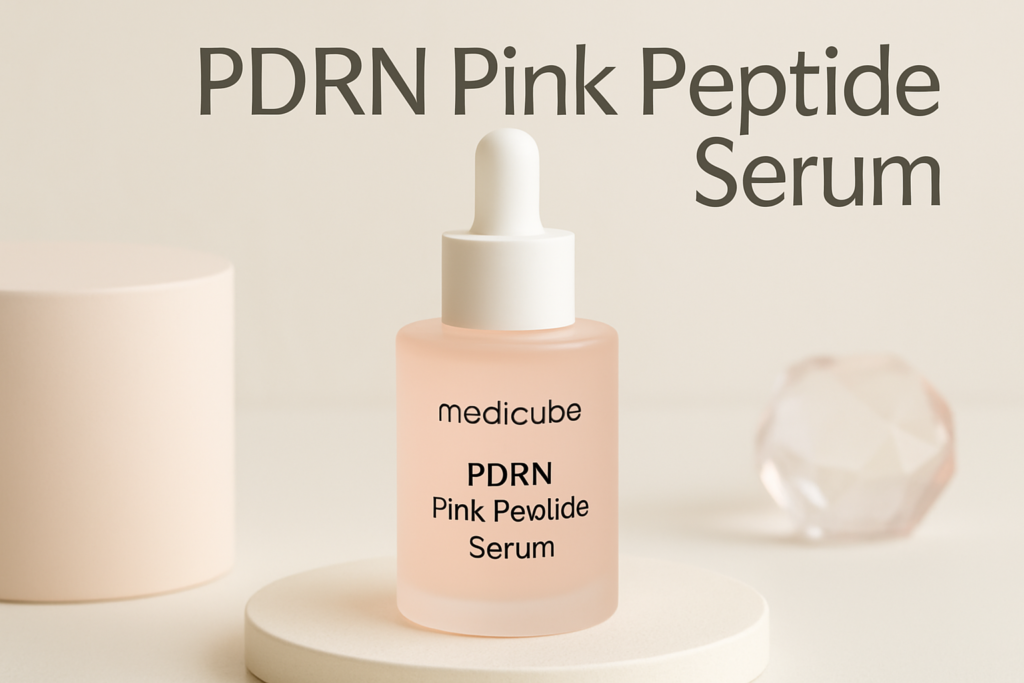
PDRN has become one of the most visible ingredient stories in current Korean beauty, and medicube is one of the brands pushing it into everyday skincare. The medicube PDRN Pink Peptide Serum is a 30 ml treatment-style serum built around PDRN, peptides, niacinamide and hydration-focused ingredients. It is designed for shoppers who want a plumper, more luminous-looking finish without committing to a rich cream.
Quick verdict
Worth considering if: you want a lightweight serum with a dewy finish, cosmetic brightening support and a modern PDRN-and-peptide ingredient profile.
Think twice if: you prefer very simple formulas, dislike trend-led ingredient marketing, need strong oil control, or expect a serum to produce dramatic changes to firmness or pigmentation.
Bottom line: this is best understood as a hydrating glow serum with a firm-looking-skin focus—not a replacement for sunscreen, a prescription treatment or an in-office procedure.
Why this Medicube serum is receiving attention
PDRN, short for polydeoxyribonucleotide, has moved from specialist beauty conversations into mainstream Korean skincare. A 2026 industry presentation from Silicon2 identified PDRN as one of the Korean beauty trend areas to watch and listed medicube’s PDRN Pink Peptide Ampoule among the products associated with that trend. The presentation also grouped PDRN with other current Korean categories such as collagen gel masks, tranexamic-acid products and beauty devices.
That does not prove that every PDRN product is a bestseller, nor does it establish a universal ranking. It does, however, provide a useful market signal: PDRN is receiving meaningful attention in Korea’s rapidly moving beauty market, while medicube is connecting the ingredient with its already prominent glow-and-device positioning.
The product discussed here is officially named PDRN Pink Peptide Serum. The official product page offers two ingredient options: Salmon DNA PDRN and Rose PDRN, described by the brand as a vegan alternative. Check the option selected at checkout, because the variant can affect the ingredient story and suitability considerations.
Product overview
medicube describes the serum as a pink glow formula for uneven-looking tone, dryness, dullness and loss of firmness. The brand also states that it is dermatologist-tested, tested to be low-irritating, fragrance-free and free of artificial color. These are brand-provided product claims rather than independent conclusions from this review.
The 30 ml bottle is positioned as a daily serum for morning and evening use. The official page lists dry and combination skin as target skin types, while the brand’s FAQ says the formula can be used by all skin types, including oily skin. That broader claim is plausible for a serum texture, but individual tolerance and finish preferences still matter more than a universal label.
The product’s color is a notable part of its identity. medicube says the pink appearance comes from cyanocobalamin, or vitamin B12, rather than artificial colorants, and that it should not stain the skin. The formula is visibly designed to support the brand’s “pink glow” concept, but the color itself does not indicate how effective the serum will be.
Key ingredients and what each does
PDRN or sodium DNA
The Salmon DNA PDRN version uses sodium DNA in the ingredient list. PDRN is a cosmetic ingredient category made from DNA fragments; in this formula, it is paired with humectants and conditioning ingredients rather than presented as a standalone active treatment.
medicube claims that its PDRN supports the appearance of a stronger, more resilient skin barrier and helps create a smoother, firmer-looking complexion. Those are cosmetic positioning statements. They should not be confused with evidence that a topical serum can reproduce the effects of clinical PDRN procedures or medical treatments.
The Rose PDRN option is presented by the brand as a vegan alternative with rose-related benefits. Shoppers should not assume that Salmon DNA PDRN and Rose PDRN are chemically identical simply because the brand places them in the same product family. Read the selected variant’s ingredient information before purchasing.
Niacinamide
Niacinamide is a well-established cosmetic ingredient used in formulas aimed at improving the appearance of uneven tone, dullness and excess surface oil. It can also support the look of a more comfortable, balanced skin barrier. The official page identifies niacinamide as one of the serum’s key ingredients, but does not give a percentage.
That missing percentage matters. A product can contain niacinamide without behaving like a high-strength niacinamide serum. In this formula, it appears to be part of a broader hydration-and-glow system rather than the sole focus.
Peptides
Peptides are short chains of amino acids commonly used in cosmetic formulas that target the appearance of firmness and fine lines. medicube highlights peptides as a key part of the product’s firm-looking-skin concept. The official page does not present a complete, detailed explanation of every peptide’s concentration or individual role, so it is more accurate to view them as supportive cosmetic ingredients rather than expect a guaranteed lifting effect.
Humectants and skin-conditioning ingredients
Glycerin, butylene glycol, betaine and several forms of hyaluronic acid appear in the published ingredient information. These ingredients attract or hold water at the skin’s surface and can make skin feel softer, smoother and more supple. Panthenol is also listed and is commonly used as a conditioning and comfort-supporting ingredient.
These hydration ingredients may be more immediately noticeable than the trendier PDRN story. A well-hydrated surface can look temporarily fuller and more reflective, which helps explain the serum’s glow-focused positioning without requiring exaggerated claims.
Vitamin B12
Cyanocobalamin, a form of vitamin B12, gives the formula its pink appearance according to medicube. Here, its most directly relevant function is visual: it creates the serum’s distinctive color. The presence of vitamin B12 should not automatically be interpreted as evidence of a major skin-brightening or anti-aging effect.
Texture and finish
The brand describes the texture as lightweight and highly moisturizing, with absorption within minutes and a soft, plump-looking glow. Based on the formula structure and the product description, shoppers should expect a fluid serum with more body than a watery toner but less richness than a cream.
The finish is likely to suit people who enjoy a fresh, reflective complexion. On dry or combination skin, it can sit comfortably under moisturizer. On oily skin, the finish may be enough on its own during humid weather, although that depends on how much is applied and what follows it.
“Glass skin” is a visual description, not a measurable skin condition. The serum may make skin look more hydrated and luminous, but it cannot permanently change pores, facial structure or the natural level of oil production.
Who is it best for?
Good fits
- Dry skin: The combination of humectants, emollient-supporting ingredients and a glow finish may work well beneath a moisturizer.
- Combination skin: Use a small amount on the cheeks and drier areas, adjusting the amount around the T-zone.
- Dull-looking skin: Niacinamide and hydration can support a fresher, more even-looking appearance over time.
- Routine minimalists who want one treatment step: The formula combines hydration, niacinamide, peptides and the PDRN concept in one serum.
- Shoppers curious about Korea’s PDRN trend: This is an accessible topical format compared with professional treatments.
Potentially poor fits
- Very oily skin: The dewy finish may feel too shiny, especially when layered with a rich moisturizer or luminous sunscreen.
- Highly reactive skin: The brand calls the formula low-irritating, but no product is irritation-proof. Patch testing remains sensible.
- People avoiding animal-derived ingredients: Choose the Rose PDRN option if its complete ingredient list meets your preferences, rather than assuming every version is vegan.
- Anyone seeking a high-strength treatment: The product page does not disclose concentrations for PDRN, niacinamide or peptides, so it is not possible to compare potency directly with percentage-led formulas.
How to use it
After cleansing and toner, apply a small amount to the face and gently press or smooth it across the skin. Follow with moisturizer if needed, and use sunscreen in the morning.
medicube says the serum can be used daily, morning and evening. The brand also suggests layering two or three applications for extra hydration. For most shoppers, starting with one layer is more practical; add more only if the finish remains comfortable and does not pill beneath later products.
If you are introducing several new products at once, use this serum alone for several days before adding another new active. That makes it easier to identify the source of any redness, itching or discomfort. Stop using it if irritation persists.
Strengths
- Combines a current Korean ingredient trend with familiar cosmetic hydrators.
- Offers Salmon DNA PDRN and a Rose PDRN vegan option.
- Includes niacinamide and peptides for a broader glow-and-firm-looking-skin concept.
- Likely to appeal to dry and combination skin that prefers a luminous finish.
- Can fit into a simple morning or evening routine without requiring a dedicated device.
- The formula is listed as fragrance-free and without artificial color on the official product page.
Limitations
- The brand does not disclose the percentages of PDRN, niacinamide or peptides on the product page.
- The PDRN terminology can sound more advanced than what a topical cosmetic serum can realistically deliver.
- The dewy finish may be too rich or shiny for some oily-skin routines.
- Results described by the brand, including visible changes in as little as two weeks, are not a guarantee for every user.
- The two variants should not be treated as interchangeable without checking the relevant ingredient list.
Buyer checklist
- Confirm whether you are buying Salmon DNA PDRN or Rose PDRN.
- Check the full ingredient list for your selected version, especially if you avoid animal-derived ingredients.
- Do not buy it solely for the word “PDRN”; evaluate the whole formula and the finish you actually prefer.
- Consider whether you already use a niacinamide or peptide serum. If so, this may duplicate rather than simplify your routine.
- Patch test before applying it across the entire face.
- Buy from the official brand site or an authorized retailer to reduce the risk of old, counterfeit or incorrectly labelled stock.
Alternatives and comparison
| Product | Best for | How it differs |
|---|---|---|
| medicube PDRN Pink Peptide Serum | Glow, hydration and a firm-looking finish | PDRN, peptides and niacinamide in a pink, dewy serum format |
| medicube PDRN Pink One Day Serum | A concentrated single-use ampoule experience | Designed as a one-day vial-style treatment rather than an everyday standard serum |
| Anua PDRN Hyaluronic Acid Capsule 100 Serum | Hydration-focused PDRN layering | More directly centered on PDRN and hyaluronic-acid capsule technology; already covered separately by TENCHOICE BEAUTY |
| Dear, Klairs EGF Blue Youth Activating Drop | Lightweight peptide-and-growth-factor-style skincare | A different ingredient direction and a lighter, less pink-focused identity; already covered separately by TENCHOICE BEAUTY |
| Beauty of Joseon Glow Serum | Simple propolis-and-niacinamide glow care | Less trend-led than a PDRN serum and built around a different soothing and brightening profile; already covered separately by TENCHOICE BEAUTY |
Final assessment
The medicube PDRN Pink Peptide Serum is a credible example of how Korean skincare is translating the PDRN trend into a wearable daily product. Its strongest case is not that PDRN will transform the skin overnight. It is that the formula brings together several useful cosmetic categories—humectants, niacinamide, peptides and sodium DNA—in a lightweight serum with a noticeable glow finish.
For dry or combination skin, especially skin that looks dull or feels dehydrated, it may be an appealing addition. For oily or highly reactive skin, the finish and variant choice deserve more scrutiny. The lack of disclosed active percentages also means shoppers should judge it by texture, routine compatibility and realistic expectations rather than by trend language alone.
Transparent editorial note
This article separates information stated by medicube from editorial interpretation. Brand claims about low irritation, dermatologist testing, visible results, PDRN benefits and suitability were not independently verified here. No personal-use testing, sales ranking, price assessment or medical evaluation is implied. Cosmetic products cannot diagnose, treat or prevent medical conditions, and “firming,” “brightening” and “barrier-supporting” refer to appearance or cosmetic performance rather than medical outcomes.